


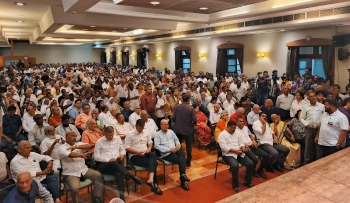
 PEOPLE’S POWER: A large crowd at the meeting at Institute Menezes Braganza hall, Panaji on Tuesday. Captured by : Narayan Pissurlenkar
PANAJI
In a resounding show of public support at the Institute Menezes Braganza hall, citizens rallied behind retired Justice Ferdino Rebello’s call for a 'People's Movement to Save Goa' and threw a gauntlet at the State's political establishment: immediate repeal of Sections 17(2) and 35A of the Town and Country Planning Act -- provisions widely blamed for fueling corruption and unchecked land-use zoning changes.
Justice Rebello who addressed the meeting at its conclusion said the demand for the repeal of these changes in the TCP Act are "non-negotiable".
"It is the source of all corruption in the State. The land is of no use to them if it cannot be converted," Rebello said.
The meeting, attended by citizens from across the State, culminated in the release of a comprehensive 10-point charter aimed at safeguarding Goa’s fragile environment, cultural heritage, and democratic ethos.
Justice Rebello, who has long been vocal about unchecked development and corruption in planning, urged Goans to unite in defense of their land.
“This is not merely about development; it is about survival of our identity and heritage,” he declared.
All seven legislators occupying the Opposition space in the Goa legislative assembly attended the meeting and were seated in the front row of the audience.
Rebello, however, cautioned that his call for the movement has no political motive and is not prompted by any political force or party.
He also made it clear that he himself harbours no intention of contesting any election for political office, now or in the future but intends to take forward the movement by giving shape to a new organisation which will have no politician in it.
Other speakers at the meeting emphasized that the charter is not merely a list of demands but a blueprint for reclaiming Goa’s future even as several expressed frustration at successive governments ignoring environmental concerns and allowing speculative real estate projects thus eroding the State’s character.
As Justice Rebello concluded, he reminded the gathering that the struggle ahead would be long but necessary: “Goa belongs to its people. If we do not act now, future generations will inherit only ruins.”
THE 10-POINT CITIZEN’S CHARTER
Protection of hills and forests: Declaring them the heritage of the people, the charter calls for an immediate halt to hill-cutting and mandates legislative amendments to stop such destructive practices.
Repeal of corrupt amendments: It demands scrapping controversial provisions of the Town & Country Planning Act that allow zoning changes, user conversions, and increases in floor area ratio. Citizens insisted these amendments are the root of rampant corruption.
Safeguarding agricultural land: The charter proposes amending the Land Revenue Code to prevent sale of farmland to non-agriculturists and non-residents. Only Goans residing in the state for at least 30 years should be eligible to own agricultural plots, and transfers must be restricted to agricultural purposes.
Carrying capacity surveys: No development in villages, towns, or cities should proceed without scientific studies of carrying capacity. The charter recommends that NEERI or similar agencies conduct these surveys, with funding allocated in upcoming budgets.
Drinking water as a right: Highlighting acute shortages, the charter insists that permissions for multi-storied buildings and gated communities be frozen until residents are assured of at least four hours of daily drinking water supply, as promised by the Chief Minister.
Sustainable development principles: All projects above Rs 5 crore must incorporate the polluter pays principle, precautionary principle, and intergenerational equity.
Review of tenancy declarations: Negative tenancy declarations issued in recent years must be re-examined by retired judges, with fraudulent applicants prosecuted. Similar scrutiny is sought for orchard lands.
Ban on development near natural assets: Projects near rivers, lakes, forests, hills, and seashores should be prohibited, reinforcing the Public Trust Doctrine.
Removal of casinos: The charter reiterates long-standing promises to remove offshore casinos from the Mandovi river within six months.
Accountability of officials: Strict departmental action, including dismissal and forfeiture of pension, is sought against officers, architects, and engineers found complicit in falsifying documents to aid developers.


