The Church in Vasco da Gama is dedicated to St Andrew, the Apostle. The parish usually celebrates the feast on November 30, the feast day of the saint, but this year since November 30 falls on the first Sunday in Advent, the feast will be celebrated on December 1.
THE ORIGIN
The first church in Vasco da Gama, built with mud walls and a thatched roof, along with the parochial house, was constructed by the Jesuits in 1570 with financial assistance from the local people. The first Eucharist was celebrated with great solemnity on April 5 the same year. Present for the inaugural Mass were Fr Alexandre Valignano, the Jesuit representative from Rome, along with 24 Jesuit missionaries and lay brothers. The celebration was preceded by a long procession carrying a large picture of St Andrew.
In 1571, the Muslims attacked Salcette and burnt the church, but it was rebuilt by April 1572. At that time, Fr Aires de Menezes was the parish priest, assisted by Br Pedro Diniz. The church and the parochial house were again destroyed by the Adil Shah’s soldiers in 1578.
As the churches made of mud and thatch were repeatedly being set on fire, the Viceroy, Ferrao Teles de Menezes, ordered that churches be constructed with stone and lime. According to the Jesuit historian Fr Sebastião Gonsalves, the church of Vasco was rebuilt in stone and lime around 1594.
The first Jesuit priest serving the parish was Fr Azias de Mendonça (1572) and the last was Fr João Pereira (1768). In all, 34 Jesuit pastors served the parish between these years. After the Jesuits left, the administration of the parish was taken over by the Diocese.
LATER DEVELOPMENTS
The church underwent repairs in 1863 and 1871. A new residence was constructed in 1934 during the tenure of Fr Rancon Pereira. Later, the parish priest Fr Antonio Couto (January 1975 “ May 1989) extended it in 1989. Major renovations and expansion were carried out in 2009 under the leadership of Fr Jose Antonio Costa.
Within the church premises is a grotto of Our Lady of Fatima, blessed by Fr Jose Antonio Costa and Fr Lino Gonsalves. The statue of Our Lady is carved in marble and accompanied by statues of the three shepherd children. On the eastern side stands a statue of St Joseph Vaz.
THE CHURCH
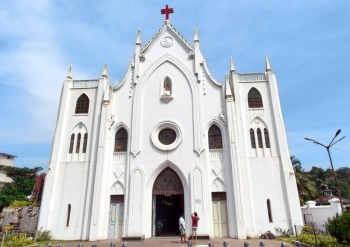
The church’s magnificent façade reflects Neo-Gothic architectural style, evident in features such as the pointed-arch windows. The original façade was later redesigned to incorporate these Neo-Gothic elements after the main structure was completed. Encased in glass on the façade is an image of the patron saint, and below it is an inscription in bold: “In Commemoration of the Centenary Celebrations of the Church “ 5-IV-1970.”
The façade features two towers on either side and another tower at the back above the main altar. The church houses two bells. The larger bell bears the inscription: “Beate Andrea Ora Pro Nobis. O-Q P. DIZ B.A. 1628.” The smaller bell is inscribed with: “Feita Pelo Mestre Dobu 1752.”
THE ALTARS
The Church has 3 altars, The main altar is dedicated to the patron, St Andrew, whose image is seen behind; on the left is the image of St Peter and to the right of Good Jesus. The altar to the right is dedicated to N. S. da Guia and below it is the image of St Anthony and St Francis of Assisi; the altar to the left is dedicated to Bom Jesus; to its left is the image of St Sebastian and right of St Rock. Down below are two other altars, one dedicated to Our Lady and the other to the Sacred Heart of Jesus.
The following chapels come under the jurisdiction of St Andrew Church: Our Lady of Merces Chapel, Vaddem, Our Lady of Piety Chapel, Mangor, Holy Cross Chapel, New Vaddem, St Sebastian Chapel, Bhuteabhatt, Patrong.