


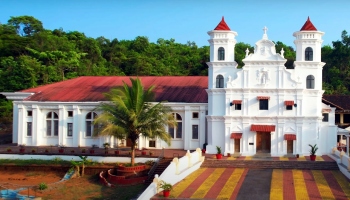
The Church at Macasana is dedicated to St Francis Xavier and although the universal Church celebrates the feast of St Francis Xavier on December 3, the parish here celebrates the Feast on December 10.
THE ORIGIN
The first chapel in Macasana was constructed in 1651 by the Communidade of Macasana, with the permission of Archbishop Dom Frei Francisco dos Martyres (1636“1652). It was placed under the jurisdiction of the Curtorim parish. While the parish priest from Curtorim celebrated Mass in the chapel, other sacraments were not administered there.
Since the chapel was far from the parish church, the Catholic community here repeatedly petitioned for permission to celebrate all the sacraments locally. Their request was partially granted when Archbishop Dom Frei Agostinho d’Anunciação (1691“1713) and later Archbishop Dom Ignacio de Santa Thereza (1721“1740) authorised the administration of all sacraments except burial, as the chapel had no cemetery.
In 1739, during the Maratha invasion of Goa, the chapel was ransacked. With government approval dated March 5, 1760, the Communidade rebuilt it and purchased a new bell with funds amounting to 325 xerafins.
In 1769, the government further granted a large portion of khazan land from the adjoining fields. On January 12, 1806, Archbishop Dom Manuel de Santa Catharina (1784“1812) granted permission to keep the Blessed Sacrament in the chapel.
The chapel was elevated to a parish in 1808; however, according to historian F. X. Catao, it was formally raised to the status of a church on August 12, 1809.
On April 29, 2005, Fr José Remedios Fernandes, the vicar general of the Archdiocese of Goa and Daman, inaugurated a Prayer Room for the spiritual benefit of the parishioners.
As the old church had become too small and was in need of repairs, the decision was taken not to demolish it but to extend it on one side. The extension was completed in 2016.
THE CHURCH
The Church stands atop a hillock, accessible by climbing 28 steps. A tarred road also leads directly to the entrance, making access convenient for all. The church displays typical Portuguese-era architectural features, reflecting the rich cultural heritage of the region.
The façade bears an image of St Francis Xavier and has two towers, one of which houses the bell. The parochial house stands to the right of the church. Behind the church, on a hill, is a statue of Our Lady under a protective canopy.
THE ALTARS
The old church had three altars: the central altar dedicated to St Francis Xavier, the right-side altar to Our Lady of Glory, and the left side altar to the Child Jesus.
The new church has a single liturgical altar. Behind it is a large image of the Crucified Christ mounted on the wall. On one side are panels depicting scenes from the life of St Francis Xavier, alongside an image of the patron saint himself. On the opposite side stands the tabernacle, designed to resemble an open book, surrounded by artistic representations of the four Evangelists. Adjacent to the tabernacle is a large statue of Our Lady.


