MAPUSA
Despite clear orders, mapped evidence of illegalities and repeated reminders from the Goa Coastal Zone Management Authority (GCZMA), La Alphonso Marina Resorts and Spa at Morjim continues to stand “ raising troubling questions about administrative sabotage, political shielding and deliberate inaction within the system.
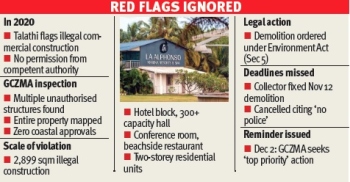
Early this month, the GCZMA was compelled to remind top district authorities to carry out its long-pending demolition order against the resort.
In a letter dated December 2, GCZMA Member Secretary Sachin Desai wrote to the North Goa Collector and District Magistrate, as well as the Deputy Collector and Sub-Divisional Officer of Pernem, urging immediate action.
“The Deputy Collector of Pernem concerned is requested to kindly execute the directions passed by this Authority on top priority,” the letter stated “ an extraordinary reminder that underscores official reluctance to enforce the law.
This was not the first deadline.
The Collector’s office had earlier fixed November 12 for demolition, but the operation was inexplicably shelved, citing the “non-availability of police personnel” “ an explanation that has increasingly become a convenient excuse in cases involving powerful interests.
The illegality of the structure is not in dispute. As far back as 2020, the Morjim talathi, in an official report, categorically stated that Dilip Sakhwala had carried out illegal construction on survey no 127/2 without any permission from a competent authority.
The structure, built for commercial use and operating as La Alphonso, was flagged as unauthorised from inception.
Subsequent GCZMA inspections revealed multiple violations. The authority mapped the entire property and found that not a single structure had been approved.
In August, invoking Section 5 of the Environment (Protection) Act, 1986, the GCZMA ordered the demolition of all constructions “ spanning a staggering 2,899 square metres.
These include a massive commercial hotel structure, a large hall with a capacity of over 300 persons, a mini conference room, a beachside restaurant with a raised platform and double-storey residential units linked to Dilip Sakhwala and others.
For complainant Sagardeep Sirsaikar, who first flagged the violations in 2020, the battle has been long and punishing.
Faced with departmental lethargy and alleged political interference, he was forced to approach the National Green Tribunal “ yet enforcement on the ground remains elusive.
“It’s impossible to believe this is administrative delay. Someone is clearly playing games. There has to be political protection or backdoor dealing to keep such a massive illegal structure intact,” said an activist familiar with the case, requesting anonymity.
With demolition orders ignored, evidence officially recorded and deadlines repeatedly breached, the continued existence of La Alphonso stands as a damning indictment of Goa’s enforcement machinery “ where the law appears negotiable, and illegality, if large enough, seems untouchable.