


PANAJI
Goa has recorded a drop in crimes committed by juveniles over the past three years, but the latest National Crime Records Bureau (NCRB) report has highlighted growing concern over the mounting backlog of cases involving minors in conflict with the law. The report also showed that none were illiterate, with most having studied up to the matriculation level.
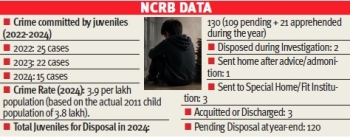
The NCRB’s Crime in India 2024 report showed that the State registered 15 juvenile crime cases during the year, down from 22 cases in 2023 and 25 in 2022. With this, Goa’s juvenile crime rate currently stands at 3.9 per lakh population.
Among smaller states, Goa’s numbers remained on par with Sikkim, which also reported 15 cases, while Mizoram recorded 46 cases. The contrast was far sharper when compared to larger states such as Bihar, where more than 5,000 juvenile crime cases were registered in 2024.
The report revealed that most offences involving juveniles in Goa fell under the Indian Penal Code (IPC) and the Bharatiya Nyaya Sanhita (BNS). One murder case involving a juvenile was recorded during the year, while property-related offences accounted for four cases, including two burglaries.
Cases involving offences against women and children constituted a substantial portion of the juvenile crimes reported in Goa, with six such incidents recorded in 2024. The State also witnessed isolated instances of rash driving and religion-related offences involving juveniles. No cases were registered against juveniles under Special and Local Laws (SLL) during the year.
Even as the overall crime figures showed a decline, the report pointed to mounting pendency before the juvenile justice system. Goa began 2024 with 109 pending cases against minors. Another 21 juveniles were apprehended during the year, taking the total number of cases requiring intervention to 130.
However, disposals remained limited. Two juveniles were discharged during the investigation, while one was released after advice and admonition. Three juveniles were sent to special homes or fit institutions, and three others were acquitted or discharged. By the close of the year, 120 cases involving juvenile delinquents were still pending disposal.
The NCRB data also provided insight into the social and educational background of minors apprehended in the State. Contrary to common assumptions linking juvenile delinquency to illiteracy or unstable homes, the report found that all apprehended juveniles in Goa had received some level of formal education.
Of the 21 juveniles apprehended in 2024, 17 had studied up to the matriculation level, three had pursued education beyond matriculation up to the higher secondary level, while one had primary-level schooling. None of the juveniles was illiterate, although the data does not rule out the possibility that some may have dropped out of the formal education system.


