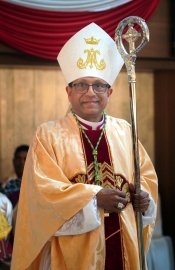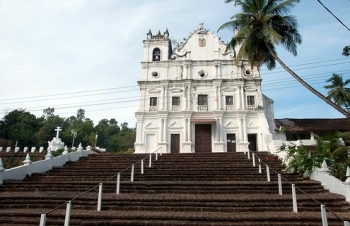
The church on a hillock on the banks of the River Mandovi at Reis Magos, Verem, is dedicated to the Holy Magi, the Three Kings. It is one of the earliest churches constructed in Goa and also the first church constructed in Bardez Taluka. The main celebrant for the Feast Mass this year is Auxiliary Bishop Simao Purifacao Fernandes.
THE ORIGIN
The Governor, Dom Pedro Mascarenhas (1554-55), entrusted Bardez Taluka to the Franciscans for the purpose of evangelisation. They came to Verem and began constructing a parochial house and also the church in 1555. The historian Frei Paulo da Trinidade says that the hill chosen for the parochial house was Maraugaru, close to the village. Well-wishers of the village gave financial help to construct these.
The reason why the church was dedicated to Reis Magos, the Three Kings, could be that the Franciscans entered Verem on January 6, the Feast of the Epiphany of Our Lord, or that the work of constructing the church started on the Feast of the Three Kings.
The entire interior was redone in 1771, and the towers were added around the year 1776. After the suppression of the religious orders, the Franciscans left the place in 1776 and the diocese took over its administration.
The first Franciscan parish priest was Frei Simao de S. Francisco and the last was Frei Henrique de S. Ana; in all, 45 Franciscans served as parish priests. The first diocesan parish priest was Frei Caetano Antonio Lobo (July 1776).
The Holy Magi Church was declared a National Monument in 1932 by the erstwhile Portuguese government. More renovation work on the church was begun in 1971. During the tenure of Fr Santa Soares as parish priest, the floor tiles were changed.
THE CHURCH
The church faces the river; it has five doorways and pairs of slender Corinthian columns divide the compartments of the façade. It displays a high carved gable decorated with scrollwork. The church’s interiors are quite impressive, with the highlight being the multi-coloured wood relief showing the Three Wise Men bearing gifts to the baby Jesus.
On the walls of the church inside are big paintings on the life of St Francis of Assisi and other Franciscan priests. The church contains the tombs of two Portuguese Viceroys, one of whom was Dom Luis de Ataide. The inscriptions on these in Portuguese and Latin are still clearly visible. The cemetery is above the church on the steep hillside. There is a small shrine near the foot of the steps of the church, which was erected in 1916, dedicated to Our Lady of Health. This was erected on the spot to commemorate the victory of Afonso de Albuquerque over the outpost in 1510.
THE ALTAR
The main altar is carved out of various woods. Above the large central space containing the tabernacle, flanked by the four evangelists, is the polychromed wooden panel of the three gifts of gold, frankincense and myrrh to the Infant Jesus seated on Mary’s knee. To its left is the image of St Anthony and to the right that of St Francis.
There are two other altars besides the main one; the one to the right is dedicated to Our Lady of Piety, and to its right is the image of St John the Baptist and to its left that of Karm Saibinn; the altar to the left is dedicated to the Assumption of Our Lady into heaven, to its left is the image of St Michael and to the right that of St Sebastian.
THE FEAST
The church celebrates the feast on January 6, the Feast of the Epiphany of Our Lord or the Three Kings. This year, the parish priests said that three boys from the village will come on horseback with their gifts of gold, frankincense and myrrh and offer them to the child Jesus. According to the historian Antonio de Menezes, during the Portuguese era, the Governor, the Bishop, the fidalgos and the Portuguese families would be present for the feast (Mirror: Dec 31, 1995).