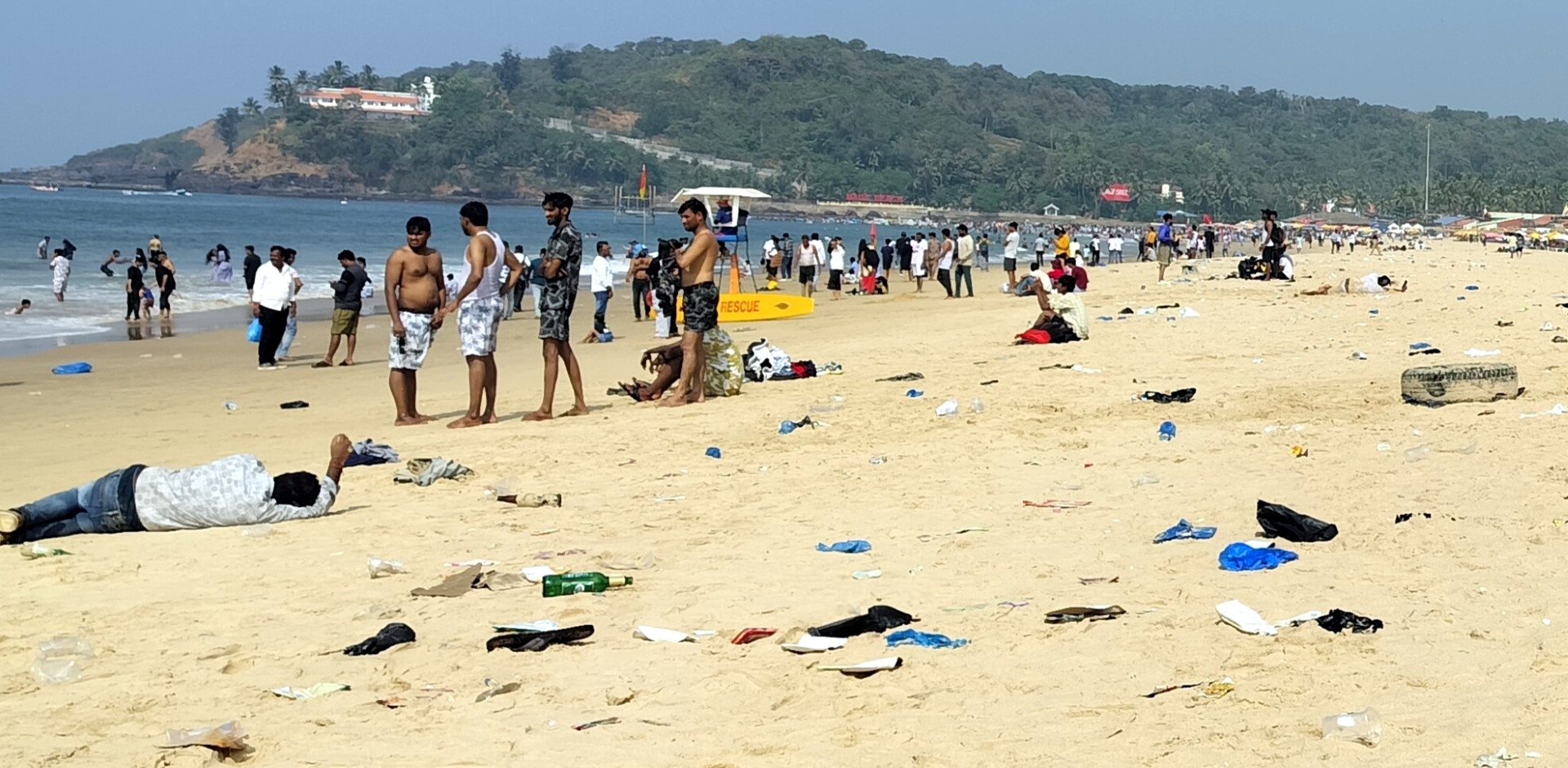
TOURIST RUBBISH: Bottles, plastic waste and debris littered along the Calangute–Baga shoreline on New Year’s morning.
MAPUSA
As the sun rose over Goa’s most famous beaches on New Year’s Day, it revealed a grim sense of déjà vu.
Beer bottles, plastic waste and broken glass lay scattered across the sands, while intoxicated tourists slept well into the morning – an all-too-familiar post-New Year tableau along the Calangute–Baga stretch.
Despite a visibly thinner crowd compared to previous years, the nuisance left behind by domestic tourists once again raised serious questions about crowd management, enforcement and the future of Goa’s tourism brand.
Shack owners and beach operators said that while the beaches were packed on New Year’s Eve, business was dismal.
“The beach was full last night, but there was hardly any business for us. The roads were completely jammed. If someone had fallen ill, it would have taken at least two hours for an ambulance to reach Baga,” said John Lobo, General Secretary of the Shack Owners Welfare Society.
Broken glass,
broken promises
The filth on the beaches was not just unsightly – it posed real danger.
Shakil, a water sports operator at Baga, described how drunken revelry often turns hazardous.
“The visitors bring beer bottles and after getting drunk, some of them break the bottles on the beach. The glass pieces get buried in the sand and washed into the water. They injure tourists and they put us at risk too,” he said.
An official photographer registered with the Tourism Department, who patrols the beaches regularly, said unruly behaviour by domestic tourists has become routine.
“When we ask them not to litter or drink openly, they simply refuse to listen. Even if complaints are made to the police, no action is taken,” he said, requesting anonymity.
Drawing a comparison, he added: “Go to Juhu Beach in Mumbai – you will see 10 to 15 guards along a one-kilometre stretch. Nuisance is not tolerated. The beach is clean. Here, enforcement is almost non-existent.”
Crowds down,
spending lower
An early morning drive along Calangute and Baga on January 1 told its own story.
Unlike previous years, roads were easily navigable and traffic was sparse.
A policeman posted along the stretch acknowledged the drop in footfall.
“There were traffic jams last night, but not like previous years. Tourist numbers were definitely lower,” the junior officer said.
Tourism stakeholders said the reduced crowd did nothing to improve business.
“This was the worst New Year’s Eve in terms of earnings. The government is doing nothing to attract quality, spending tourists or to protect those who depend on tourism,” Lobo said.
Manuel Cardozo, of the Traditional Shack Owners Association, echoed the concern.
“By midnight, Calangute was almost empty. In earlier years, activity would continue till 5 am. This time, everything shut down very early,” he said.
Foreigners missing,
reputation bruised
Perhaps the most telling indicator was the near absence of foreign tourists. While small pockets of Candolim still saw a limited foreign presence, Baga was almost entirely dominated by domestic visitors.
“How will foreigners come to Goa?” Lobo asked.
“There is already a campaign on social media that domestic tourists harass foreigners, haggle aggressively, and even trouble them for photographs. This damages Goa’s image globally,” he added.
Administration
on the defensive
Senior government officials privately admitted that crowd behaviour and waste management remain major challenges during peak events like New Year, though no concrete enforcement plan was visible on the ground.
Tourism Department sources said cleanliness drives were undertaken early on New Year’s morning and insisted that police deployment was “adequate,” but stakeholders argued that post-event clean-ups cannot replace real-time regulation.
Same scene,
another year
As tourists trickled away on January 1, what remained was a bitter aftertaste –dirty beaches, broken glass, sleeping revelers and frustrated locals.
The scenes mirrored last year almost exactly, reinforcing the perception that despite repeated warnings, there is still no comprehensive plan to regulate crowds, enforce discipline or restore dignity to Goa’s beaches.
For many who depend on tourism for survival, the question now is not just about numbers – but about what kind of tourists Goa wants and whether the government has the will to draw that line.