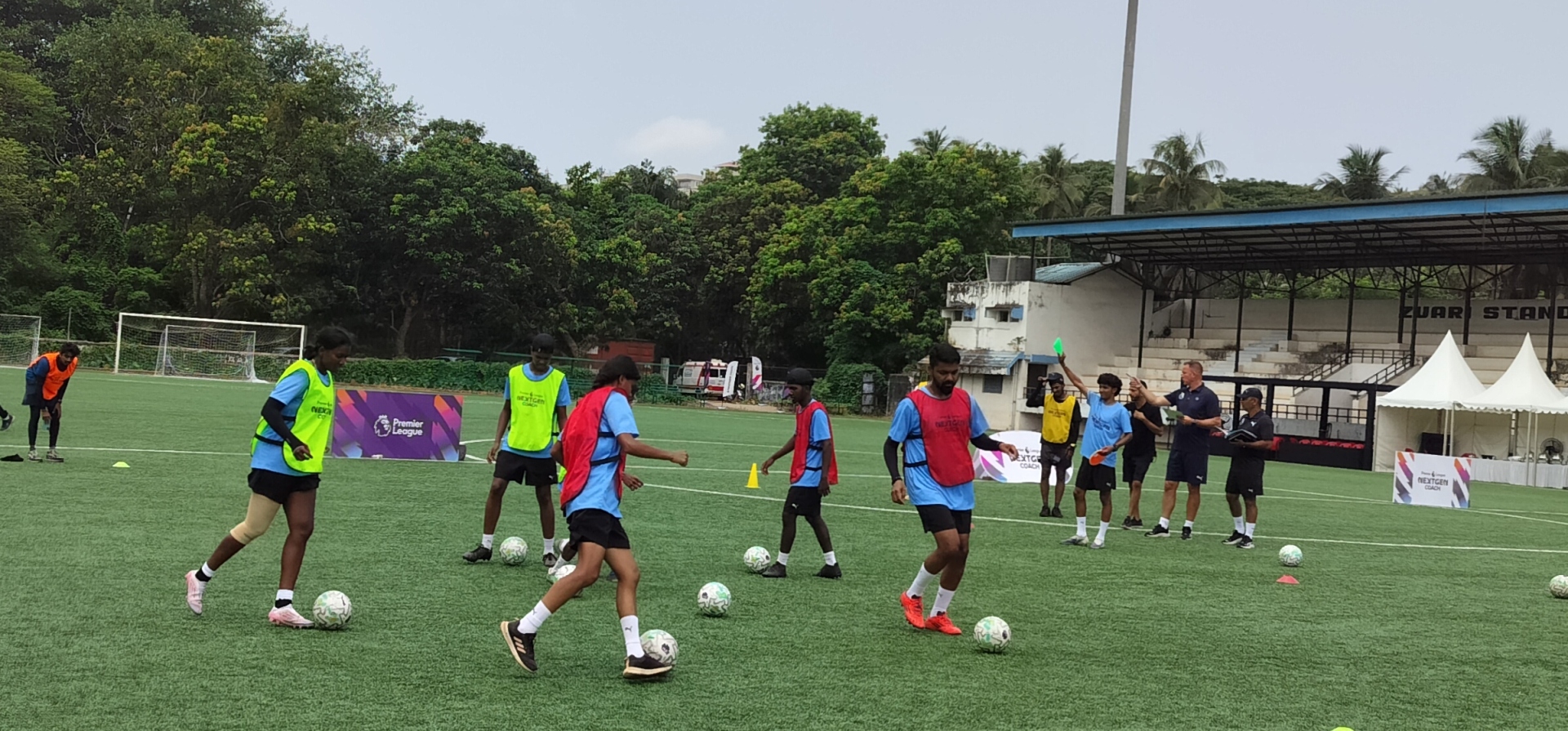
SHAPING THE FUTURE: Trainee Indian coaches undergo practical drills under the watchful eyes of Premier League experts and Indian alumni coaches during a session at Duler Stadium, Mapusa, on Tuesday.
MAPUSA
Goa’s rich football legacy can only be revived through stronger grassroots structures and better-trained coaches, according to alumni coach Shekhar Kerkar, who believes the State has “lost track” despite having the passion and infrastructure for the sport.
Kerkar stressed that Goa’s football revival depends on systematic execution of grassroots plans rather than merely announcing policies.
“After declaring football as a State sport, from there onwards we lost the track. We have many things in place, but we have to execute our plans. If execution and monitoring are done from the bottom level, you increase the pool of players,” Kerkar said while speaking to The Goan during one of the Premier League’s session at Duler Stadium in Mapusa.
The four-day programme, organised by the Premier League as part of its 18-year engagement with Indian grass roots football, brought together over 30 coaches from across India for intensive coach education sessions led by Premier League experts and Indian alumni coaches.
The initiative reflects a broader shift in football development – from focusing only on elite competitions to investing heavily in grass roots coaching ecosystems.
Kerkar, a physical education teacher from Aldona and part-time AIFF coach educator, said the State once stood at the pinnacle of Indian football.
Recalling Goa’s golden era under legendary coach Armando Colaco, he noted that “seven to eight players from Goa regularly donned national colours,” something rarely seen today.
According to him, the decline is directly linked to weakening grass roots systems.
“These types of coaches are important to create that pool at school level, community level and in villages across Goa,” he said.
Kerkar himself is a product of the Premier League’s long-term coach education programme that began in India in 2014.
He recalled how an initial group of nearly 80 coaches from Goa, Kerala and Kolkata was gradually narrowed down through a rigorous two-year process, with only 12 eventually qualifying as Level 1 coach educators.
“That programme changed the way we coach. The way sessions are conducted changed completely. Questioning skills were trained well under this programme and it helped me become a better coach educator,” he said.
The current Next Gen Coach Programme aims to pass those learnings to a younger generation of grass roots coaches. The emphasis is not merely on tactics, but on creating safe, inclusive and engaging environments for children.
Premier League coach Carl Plunkett, who has worked in the academies of Chelsea, Fulham, Reading and Crystal Palace, said he found Indian grass roots coaches remarkably similar to those in England in terms of enthusiasm and football understanding.
“The difference is mainly confidence and willingness to try new ideas,” Plunkett observed. “We are sharing knowledge and new ways of thinking, and they will use that with young children in their communities,” he added.
Plunkett underlined that modern grass roots coaching extends beyond technical drills. One of the programme’s major themes has been safeguarding and child welfare.
Fellow Premier League coach Graham Robinson described the programme as a “two-way conversation” rather than a one-sided transfer of expertise.
“We are not specialists in India. We are here to understand the local coaching environment and support their development,” Robinson said.
The programme marks another chapter in the Premier League’s growing investment in Indian football development, particularly after establishing its India office.
More importantly, it signals a recognition that India’s football future may depend less on short-term tournaments and more on empowering coaches who work daily with children at the grass roots level.