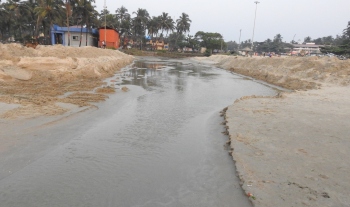
 File photo of Colva beach.
MARGAO
The South Goa district administration has moved to put the record straight on pending demolition orders along the coastal belt of Colva village, directing the Goa Coastal Zone Management Authority (GCZMA) to urgently review all existing and pending demolition orders, keeping in mind the environmental sensitivity of Coastal Regulation Zone (CRZ) areas.
In a letter to the GCZMA Member Secretary, Deputy Collector Rohan Loliyekar referred to reports that a number of demolition orders remain unexecuted due to the failure to clearly identify the structures slated for demolition. He called upon the authority to issue “clear, specific and unambiguous” orders that leave no scope for confusion at the implementation stage.
Loliyekar stressed that demolition orders must clearly identify each unauthorised structures with reference to survey numbers, PT sheets, Chalta numbers, subdivisions, CTS particulars, precise location, extent of violation, supported by site plans, maps, photographs, and measurements.
He further instructed the GCZMA to issue corrigenda or revised orders wherever earlier directions are found to be deficient, vague, or incapable of effective implementation, so as to make them legally enforceable and executable on the ground.
The Deputy Collector also recommended the explicit incorporation of directions for the immediate cessation of all commercial, construction, renovation, or allied activities ” including the use of machinery ” pending execution of demolition orders, in order to prevent further aggravation of violations.
Emphasising coordination, Loliyekar underlined the need for close cooperation with the district administration, the in-charge of South Goa demolition squads, and other line departments to ensure time-bound and lawful execution of demolition orders. He also suggested the establishment of an internal monitoring mechanism to periodically review compliance and prevent recurrence of similar lapses.
“The matter is of considerable environmental significance and involves larger public interest. Any continued delay or ambiguity in enforcement is likely to cause irreversible ecological damage and may also attract adverse judicial and statutory scrutiny,” the Deputy Collector stated.
Loliyekar was referring to recent media reports in which the Colva Civic and Consumer Forum Secretary Judith Almeida had expressed serious concern over continued inaction in enforcing demolition orders along the Colva beach belt.
According to the Forum, vague, incomplete, and non-specific directions issued by the competent authority have led to prolonged delays in execution.
The letter noted that demolition orders currently in force do not clearly or unequivocally identify the unauthorised structures due to the absence of precise survey particulars, site plans, measurements, maps, photographs, and ground-level demarcation. This lack of specificity, it stated, has resulted in confusion during execution and allowed commercial establishments to continue operating despite subsisting demolition orders and statutory prohibitions.
The Deputy Collector further observed that these deficiencies have enabled not only the continuation of existing violations but also fresh unauthorised construction and commercial activity, including the use of heavy machinery, in ecologically sensitive coastal stretches, despite court-mandated directions to maintain status quo.
Reiterating the legal position, Loliyekar emphasised that issuing clear, precise, and enforceable directions is a fundamental requirement for effective implementation of the CRZ Notification and the Environment (Protection) Act, 1986. Vague or ambiguous orders, he warned, frustrate enforcement, weaken deterrence against violations, undermine the intent of environmental regulation, and erode public confidence in the regulatory framework.