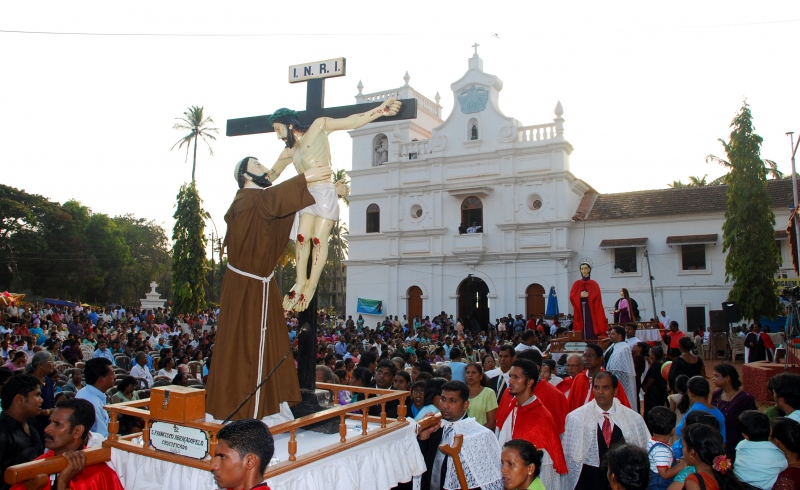
File photo of the Procession of Saints (Santanchem Pursanv) at Goa Velha.
Goa Velha village traditionally comes alive on the fifth Monday of Lent, when thousands of people, irrespective of their faith, flock to this village to witness the traditional Santanchem Pursanv, the Procession of Saints.
The Santanchem Pursanv is a unique procession that annually takes place at St Andrew’s Church in Goa Velha. People of all faiths, rich and the poor, participate to seek blessings for themselves through the intercession of the Saints. However on account of the Covid pandemic, the Santanchem Pursanv has been cancelled this year.
ORIGINS
The Santanchem Pursanv is a reminiscent of the past glory of the city of Govapuri (old name of Goa Velha). The procession was started by the Franciscans in the 17th century to inculcate a sense of spirit of prayer and penance into the minds and hearts of the faithful. They placed before them the Saints as role models who were actually simple people belonging to this world, and who devoted their lives to Christ, thereby sanctifying themselves.
The church dedicated to St Andrew in Goa Velha became a separate parish in 1583. The Franciscans started a procession of the Franciscan Third Order as a theme for the Lenten Season.
At this time, local Catholics narrated to them the former glories of Govapuri (old name of Goa Velha), the grand procession of pundits and monks of old which had become a tradition, and the need to revive them. The Franciscans were hesitant to start the same as they felt that the Church does not encourage reverence to the living, or acknowledge them as saints. However, to satisfy the craving of the local population, they tried to revive the traditional procession.
Towards the end of the 17th century, they instituted a Penitential Procession of Saints in which 65 life-sized images belonging to the Franciscan and other Orders were taken through the streets of Goa Velha and were presented to the people as models for imitation.
To meet the expenses of this procession, Comendador Joao de Menezes, a member of the Terceira Ordem (Secular), instituted a fund of one thousand xerafins.
After the suppression of the religious orders, the procession was stopped for a while, and many images of the saints and the vestments were destroyed. The same was restarted in 1868 by the Franciscan Third Order of Laymen. Thus, with the new St. Andrew’s Church, the Procession of Saints returned to Goa Velha.
THE PURSANV
The Pursanv (procession) begins soon after the evening Eucharistic celebrations in the Church square. Life-sized images of saints are brought out in order from the main door of the Church, and kept in front of the outdoor altar, where the priest gives a brief idea of the saints to the faithful.
Then, the images are taken around the square, and then out on the street road, beginning with the Armas Franciscanas charol, followed by other images of the saints on the shoulders of the Church confraria. The last charol is the image of St Francis of Assisi seeing a vision of our Lord Jesus Christ crucified. At the end is the ‘Veil of Veronica’ carried by the priest in his hands, covered by a canopy.
The faithful pray the rosary right throughout the procession, and the youth choir sings hymns after each decade of the rosary. The procession crosses the Goa Velha market, then to the old national highway, winding up back in the church square, where the images are arranged in a semi-circle. The whole procession takes about two hours.
As the procession moves on the street lanes through the crowd, devotees duck under the charols to receive blessings through the intercession of the saints, and to obtain purification for their confessed sins.
In the Church Square, the priest preaches a sermon to the faithful. After this, the images of the saints are taken back inside St Andrew’s Church and kept in order for three days for public veneration. When the procession began, there were 65 life-sized richly decorated statues of saints and martyrs but now, there are just 31 statues left.
(The writer is former director of Thomas Stephens Konknni Kendr at Porvorim)