


MARGAO
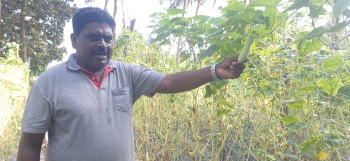
From the dust of Goa’s once-thriving mining belt to the fertile fields of Raia, former sarpanch Judas Quadros has carved out a remarkable second innings as a successful agriculturist.
After the closure of mining activities in 2012 left many without a steady source of income, Quadros turned to farming as a means of survival.
What began as a modest effort on a small plot of land has since grown into a sustainable livelihood. Today, he cultivates a variety of local vegetables, including chillies, bottle gourd, and cluster beans, supplying his produce to the Goa Horticulture Corporation.
Quadros recalls 2019 as a particularly rewarding year, when his farm recorded a bumper harvest of chillies. “We harvested nearly two tonnes that season,” he said, underscoring the potential of small-scale farming when supported by favourable conditions.
Despite such successes, Quadros points out that challenges do persist. Like many farmers in the State, he is urging the government to revise procurement rates for locally grown vegetables to make farming more economically viable. “We had met former Agriculture Minister Ravi Naik with a plea to revise the rates. Prices have not been updated in the last five years,” he noted.
He also acknowledged the support extended by Curtorim MLA Reginaldo Lourenco, stating that the legislator has consistently assisted farmers at every stage ” from tilling the land to harvesting the crops. “Agriculture is in the blood of our Curtorim MLA Lourenco. He provided help and assistance and that makes agriculture remunerative since it helps to save cost,” he said.
Quadros says the water stream passing through the fields have facilitated the farmers to irrigate the fields. “The vegetables grown by the local farmers, especially tambi bajji is free from preservatives. You can easily find out which is locally grown and the vegetable that comes from outside with preservatives,” he added.
Quadros’ journey reflects the resilience of Goa’s farming community, as many continue to adapt and rebuild their livelihoods in the face of changing economic realities.


