


MARGAO
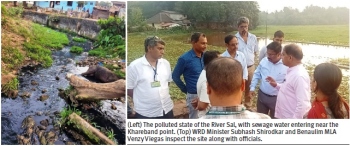
Water Resources Department (WRD) Minister Subhash Shirodkar on Saturday witnessed first-hand how raw sewage is flowing into the river, contaminating what is considered the lifeline of Salcete.
The minister’s visit comes amid growing concerns from local representatives and residents about the deteriorating health of the river due to untreated sewage discharge.
Accompanied by Benaulim MLA Venzy Viegas and WRD officials, Shirodkar visited several locations where storm water nullahs are reportedly carrying untreated sewage from Margao city directly into the River Sal. The inspection highlighted the absence of an effective mechanism to treat sewage before it enters the river system.
Alarmed by the gravity of the situation, the WRD Minister suggested a more focused approach to the proposed rejuvenation project. Instead of attempting restoration along the river’s entire 50-kilometre course, Shirodkar proposed implementing rejuvenation works in smaller stretches of about 1“2 kilometres at a time to ensure effective execution and monitoring.
During the inspection, Viegas pointed out specific storm water drains that discharge waste from Margao into the river and warned that the River Sal could “die a slow death” if immediate corrective measures are not taken. The MLA urged the government to expedite the rejuvenation project and restore the river to its original ecological state within a defined timeframe.
Following discussions with the MLA and officials, Shirodkar instructed WRD authorities to prepare a detailed action plan and submit a report by Friday. He also directed officials to conduct joint inspections of pollution points, particularly the storm water nullahs, along with representatives of the Sewage Infrastructure Development Corporation of Goa Ltd (SIDCGL) to assess the scale of the problem and recommend remedial measures.
Speaking to the media at Khareband Bridge after the inspection, Shirodkar reiterated the need for a phased approach. “Instead of planning rejuvenation along the entire 50-km stretch of the river at once, it would be more practical to begin with smaller stretches of 1“2 kilometres for more effective implementation,” he said.
Responding to questions about the storm water drains carrying Margao’s waste into the river, the minister said concerned agencies would be directed to put systems in place to ensure that sewage discharged through the nullahs is treated before entering the river. “I have personally seen the condition of the River Sal. I will follow up on the issue and conduct inspections every month to monitor progress,” Shirodkar added.
Addressing concerns over sewage treatment capacity, the minister noted that SIDCGL may currently lack the infrastructure to treat the estimated 100 million litres per day (MLD) of sewage generated in the area. However, he said both SIDCGL and the Public Works Department (PWD) are working on implementing vacuum sewer technology in low-lying parts of Margao city where laying conventional underground sewer lines is not feasible.
“Officials have informed me that the vacuum sewer technology is expected to be installed in Margao within the next two months,” he said.
One of South Goa’s major rivers, River Sal originates near Verna and flows through several villages before emptying into the Arabian Sea near Betul. Over the years, environmentalists and local residents have raised repeated concerns about the increasing pollution in the river due to sewage discharge, urban runoff, and encroachments.


