While Siolim saw phased road development soon after the 2022 election, Mapusa’s late surge in hotmixing has sparked debate over governance timing and electoral optics
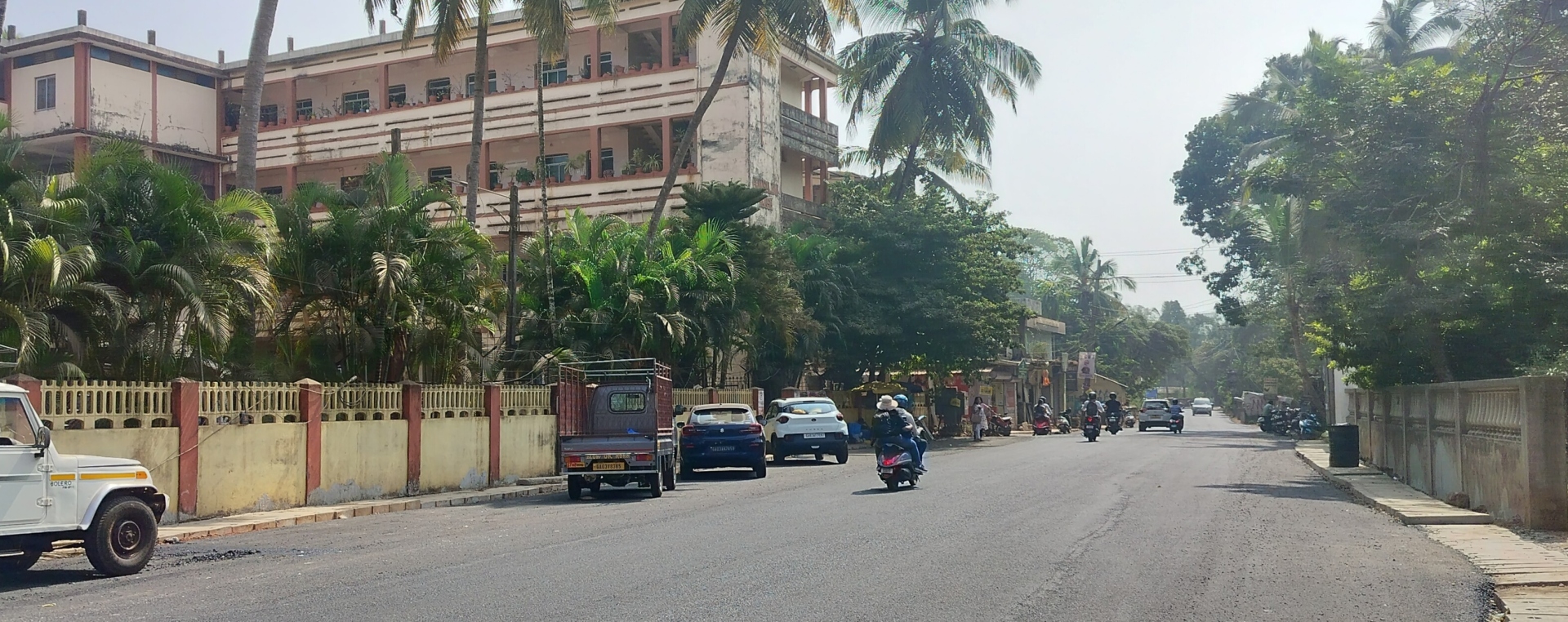
ROADS REVAMP: The widened and newly hotmixed stretch outside the popular SFX School and Higher Secondary in Siolim-Marna, one of several road improvement works undertaken across the constituency over the last two years.
MAPUSA
For years, Goa’s electoral cycle has followed a familiar infrastructure rhythm: roads remain dug up, uneven or partially repaired through most of a legislator’s tenure, only to suddenly witness frantic hotmixing and resurfacing in the final stretch before elections.
Across many constituencies, voters have come to treat pre-election road works almost as a seasonal exercise rather than a sustained governance programme.
What makes the recent contrast between Siolim and neighbouring Mapusa politically noteworthy is not merely the scale of road works, but the timing of them.
Different timing
In Siolim constituency, road restoration, widening and hotmixing began gathering pace almost immediately after the 2022 assembly election and continued steadily over the next two to three years. In Mapusa, however, significant hotmixing activity in prominent urban pockets – including the Mapusa market area, sub-yard, bus stand belt and parts of Angod – has become visible only in recent months, barely eight to nine months before the next assembly election cycle is expected to begin dominating the political landscape.
The distinction matters because roads are among the most visible indicators of governance continuity.
When road works are compressed into the final year of a government’s term, they are often viewed by voters less as infrastructure planning and more as electoral signalling.
In Siolim, the pattern appears different.
Siolim’s phased model
Since 2022, multiple road stretches across villages such as Sodiem, Marna, Oxel, Assagao, Verla-Canca and Anjuna underwent phased interventions involving widening, hotmixing, reinstatement after underground cabling, culvert reconstruction and drainage-linked road repairs.
The projects were geographically dispersed and executed over successive financial cycles rather than concentrated into a single pre-election burst.
The Rs 6.02 crore Marna-Sodiem link road project, the extensive reinstatement of roads damaged by underground utility works, the Rs 9 crore hotmixing and restoration stretch from St Agnel Institute to Anjuna Beach, the Assagao-Anjuna corridor improvements, widening projects in Verla-Canca and multiple internal road upgrades collectively indicate a constituency where road works became part of an ongoing administrative agenda rather than an election-year urgency.
“The widening and levelling of roads in Siolim-Marna has brought a visible change to the village. For years, residents had struggled with damaged and uneven roads, especially during the monsoons. Today, most of these stretches are smooth, safer and far more motorable,” said Joaquim Barros, a resident of Siolim-Marna and an active member of the gram sabha.
Mapusa’s pre-poll surge in works
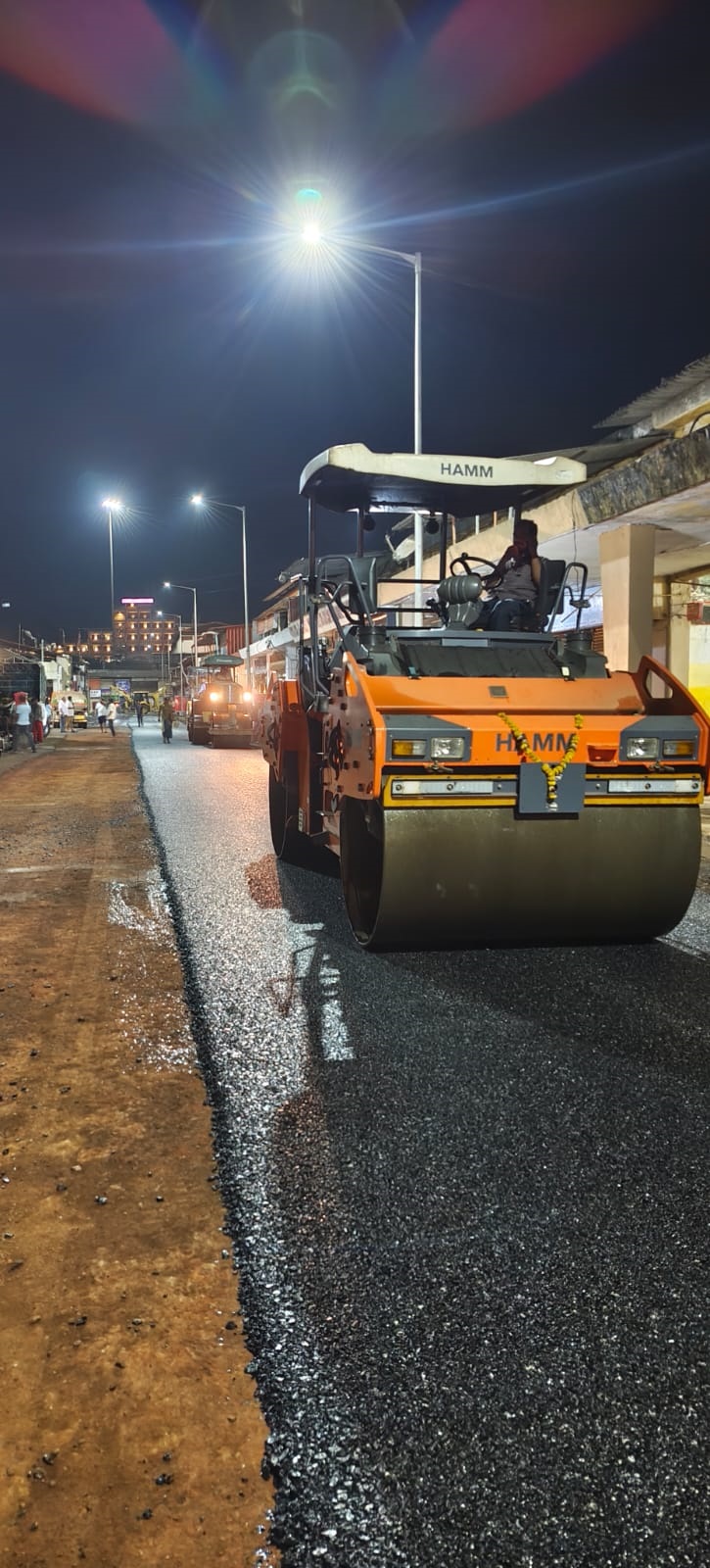
RACE AGAINST TIME: After nearly three years of deteriorating conditions and commuter complaints, roads in the busy Mapusa market area are finally receiving a fresh layer of hotmixing ahead of the election season.
By contrast, the sudden acceleration of hotmixing works now visible in Mapusa has triggered the kind of political conversations that frequently emerge late in an electoral cycle.
Traders and commuters in the market and bus stand areas – among the busiest urban stretches in North Goa – have long complained about broken surfaces, congestion and poor riding conditions. Yet large-scale resurfacing activity in many of these zones became prominent only recently.
When road works intensify only months before elections, opposition parties inevitably portray them as cosmetic governance – highly visible but delayed.
“For nearly four-and-a-half years, Mapusa saw very little serious attention being given to its roads despite repeated complaints from residents, traders and commuters. Suddenly, with elections barely months away, there is a rush to hotmix roads. People are not blind to the timing. It gives the impression of a last-minute political exercise aimed more at optics than long-term planning,” said Mahesh Rane, a local resident and President of Together For Mapusa.
Governance optics
Political observers note that first-time MLA Delilah Lobo appears to have benefited from starting infrastructure execution early in her tenure. By initiating road restoration and hotmixing works soon after the 2022 mandate, her constituency avoided the perception of a last-minute infrastructure scramble that frequently dogs incumbents in Goa. That does not necessarily mean every road in Siolim is problem-free, nor does it suggest Mapusa’s recent works lack public value.
Many of the ongoing resurfacing efforts in Mapusa are badly needed and welcomed by residents. But politically, the difference lies in whether road development is perceived as a continuous governance exercise or a pre-election corrective measure.