PANAJI
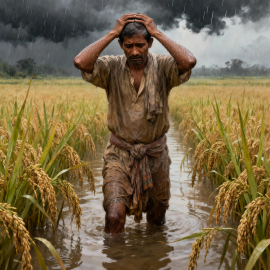
As erratic rainfall and rising temperatures continue to disrupt Goa’s agricultural cycles, traditional paddy farmers are increasingly looking at climate-resilient strategies to safeguard their livelihoods.
The past few seasons have seen significant crop losses due to unpredictable monsoons and saline intrusion, prompting urgent calls for intervention from scientists, policymakers, and the farming community.
At the forefront of these efforts is the ICAR-Central Coastal Agricultural Research Institute (ICAR-CCARI), located in Ella, Old Goa. Scientists here have developed climate-resilient paddy varieties tailored to withstand coastal salinity and erratic weather patterns.
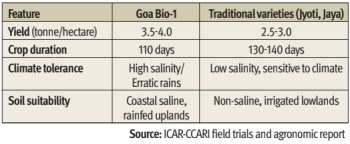
Among the most promising is Goa Bio-1, a short-duration rice variety suited for rainfed uplands and saline-prone coastal soils. This variety not only tolerates adverse conditions but also promises higher yields and economic viability.
“Goa Bio-1 has shown remarkable adaptability in field trials,” says Dr Ramesh Naik, a senior agronomist at ICAR-CCARI. “It’s an eco-friendly solution that can generate an additional net income of ₹22 crores annually if adopted across 18,000 hectares of coastal saline soils in Goa,” he argues.
Other recommended interventions include hybrid rice cultivation in coastal zones, bioengineering measures for soil and water conservation, and crop diversification with groundnut and cowpea in rice fallows. These strategies aim to reduce dependency on single-season paddy and improve overall farm resilience.
Local farmers are warming up to these innovations, but stress the need for broader support. “We are ready to adopt new methods, but we need help with training and access to seeds,” said Prakash Gaonkar, a paddy farmer from Canacona. “The climate is changing faster than we can adapt," he adds.
Policy experts are urging the State government to scale up investments in climate-smart agriculture. Goa's unique, below-sea-level khazan lands, which are famed for their nature-driven farming methods but also sensitive to climate change, are one area that is begging for attention.
"The government can do so much. This unique khazan farming system is labour-intensive, and we must invest in building tractors, transplanters, and de-weeders that can operate in these waterlogged fields," said Elsa Fernandes, president of the Khazan Society of Goa. "Waterlogging is the hallmark of khazan land. Goa has still not achieved a single mechanised intervention for the khazan fields," Fernandes said, suggesting that efforts must be made in that direction.
Fernandes also opined that the Goa agriculture policy, which is already in place, could potentially improve the State's agriculture profile substantially.
"Even if it (the agriculture policy) was partly implemented to support farmers facing hardships due to climate change, it would have directly impacted the State's gross agricultural production positively," Fernandes added. "If this policy does not find action, it would be the State's biggest failure. Good governance has to foresee the problems before they occur, not resort to firefighting after they occur," Fernandes said.
With rice cultivation covering over 52,000 hectares in Goa ” mostly rainfed ” the stakes are high. The average productivity stands at 2.8 tonnes per hectare, but climate stress threatens to push this figure lower unless adaptive measures are widely implemented.