PANAJI
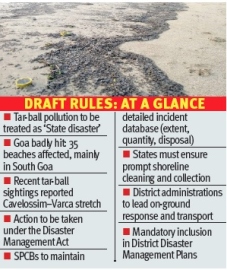
The Ministry of Environment, Forest and Climate Change (MoEF&CC) has unveiled draft Tar-Ball Management Rules, 2026, directing coastal States to treat tar-ball pollution as a “State disaster” and put in place a centralised, public reporting mechanism to tackle the recurring environmental threat.
The draft assumes importance for Goa, which has been grappling with the tar ball menace for over a decade now, with as many as 35 beaches affected, most of them in South Goa, impacting tourism and fragile coastal ecosystems. Last week too, tar ball appeared along the coastal stretch of Cavelossim to Varca, ahead of monsoon season.
The draft mandates State governments to establish a centralised reporting system under State Level Crisis Management Groups constituted under the National Oil Spill Disaster Contingency Plan (NOS-DCP). This system is intended to allow citizens to report sightings of tar balls, improving real-time response and monitoring.
The rules also require States to formally declare tar-ball pollution in coastal areas as a “State disaster” and initiate action under the Disaster Management Act bringing greater urgency and institutional backing to response measures.
On the other hand, the State Pollution Control Boards (SPCBs) are required to maintain a detailed database of tar-ball incidents, including the extent of affected coastline, quantity collected and processed, and disposal outcomes in a prescribed format.
States have been tasked with ensuring prompt shoreline cleaning and systematic collection of tar balls. The draft emphasises a coordinated response involving district administrations and multiple agencies, including disaster management authorities, coastal zone bodies, environment departments and port authorities.
As per the draft, District administrations will act as the frontline agencies responsible for collection, handling and transportation of tar balls from affected beaches. They are also required to incorporate tar-ball management into District Disaster Management Plans and maintain dedicated response teams for shoreline clean-ups.
The State government must further ensure temporary storage and safe transport of collected tar balls to authorised Treatment, Storage and Disposal Facilities (TSDFs) in an environmentally sound manner.
To move beyond reactive clean-ups, the draft rules require States to compile time-series data on oil spills and tar-ball formation events. They must also collaborate with research institutions to develop predictive models that can aid in advance preparedness and decision-making.
The SPCBs working alongside the Central Pollution Control Board (CPCB), has been assigned key regulatory and monitoring responsibilities under the draft framework. It must also ensure that tar balls are disposed of only at authorised facilities and support implementation through dedicated funding or budgetary provisions.
The CPCB will provide technical assistance, develop standard operating procedures (SOPs), and create an online system within a year to track implementation of the rules. Both CPCB and State Boards are expected to publish lists of authorised treatment and disposal facilities.
The draft also lays down liability provisions, making oil facility operators accountable for spills that lead to tar-ball formation, with provisions for environmental compensation to cover clean-up costs and damages.