


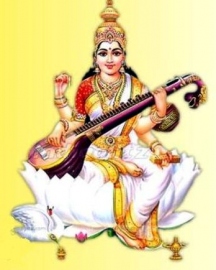
Vasant Panchami, a famous festival heralding the start of spring, is celebrated every year on the fifth day of the bright half of the Hindu luni-solar calendar, month of Magha, which falls on February 16 this year. Vasant means “spring” and Panchami means “fifth day”. It is celebrated equally by Hindus, Muslims and Sikhs in various ways, depending on the region.
Vasant Panchami festival, for many Hindus, is dedicated to goddess Saraswati, their ancient goddess of knowledge, language, music and arts. The goddess Saraswati has four hands which symbolise ego, intellect, alertness and the mind. She carries a lotus and scriptures in two of her hands and with the other two, she plays music on the veena (an instrument similar to a sitar). Her white dress symbolises purity. She is the energy of Brahma and she symbolises creative energy and power in all its form, including longing and love (kama).
Vasant Panchami is considered as the birthday of goddess Saraswati, the goddess of learning, hence students seek the blessings from Saraswati. This ritual of initiating education in kids is known as Akshar-Abhyasam or Vidya-Arambham, one of the rituals of Vasant Panchami.
Legends
A story relates to the love aspect of the day, which is about Shringara Rasam. As per mythology, Kamdeva’s wife Rati did 40 days of severe penance to bring her husband back to life, who was turned to ashes by Lord Shiva. It was on this day that Shiva brought Kamdeva back to life. This is why, Kamdeva, the god of love and desire, is worshipped with his wife Rati on Vasant Panchami.
There is a popular folklore associated with the festival related to the legendary poet Kalidasa. Kalidasa was a simpleton who was tricked into marrying a princess who didn’t respect him. A dejected Kalidasa tried to take his life but just before he could commit suicide, goddess Saraswati appeared to him and asked him to take a dip in the river. Kalidasa did so and emerged from the water an intelligent, knowledgeable and cultured person, who would eventually become a renowned poet. This is why on this day; the goddess is worshipped so that she may bestow the gift of knowledge on her devotees.
Celebrations in Goa
The festival is popularly celebrated at Shantadurga temple in Queula at Ponda, Mangesh temple (Priol), Mahalsa temple (Mardol), Ajoba temple (Querim-Pernem) and Mahalaxmi temple (Amone-Bicholim).
On Vasant Panchami, Hindus wake up early, clean their houses and the puja area and take a bath to perform the Saraswati Puja rituals. Since yellow is the favourite colour of goddess Saraswati, they put a paste of neem and turmeric all over the body before taking bath. After bath, they dress in yellow-coloured clothes.
The Saraswati Puja is then performed in the puja area. The idol of goddess Saraswati is placed in the centre and along with it an idol of Lord Ganesha is also placed by her side. Books/notebooks/musical instruments/or any other creative art element can also be placed near the idol. Then, a plate decorated with turmeric, kumkum, rice, flowers is offered to Saraswati and Ganesha to seek their blessings. Then a small lamp/incense sticks are lit in front of the idols and with the eyes closed and palms of the hands joined, Saraswati Puja mantra and Arti are recited. Once, the puja rituals are over, prasad is shared among family and friends.
They also prepare a special pastry called ‘kesar halwa’ or ‘halva', a pastry made from flour, sugar, nuts, and cardamom powder, saffron strands, which gives it a vibrant yellow colour and mild fragrance. Some add saffron to their rice and eat after cooking, as part of an elaborate feast. In many states, people celebrate by flying kites.
The day is considered very auspicious to start any work, to get married or perform Griha Pravesh (house-warming ceremony).
(The writer is former director of Thomas Stephens Konknni Kendr at Porvorim)


