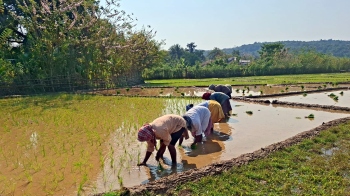
Vayangani paddy cultivation has gained momentum in the Nanoda, Derode and Dongurli areas of Sattari taluka. The transplantation of paddy is almost complete, and the weeding process is expected to begin shortly.
The crop is likely to mature within the next two months, raising hopes of a good harvest. This traditional method of cultivation has been followed in Sattari for many years and uses water from nearby rivers.
Sattari taluka is mainly agrarian, with large-scale cultivation of mango, cashew, coconut, banana and areca nut. In the past, monsoon paddy cultivation was common. However, paddy production declined due to wild animals, uncertain rainfall and damage caused by strong winds.
In this situation, Vayangani paddy cultivation has helped a few villages continue paddy farming in good quantity. At present, Vayangani farming is in full swing in Nanoda, Derode and Dongurli, using river water for irrigation.
Farmers say Vayangani cultivation gives a good yield. As it is carried out outside the monsoon season, it is less affected by irregular rainfall and strong winds. The planting work began about one-and-a-half months ago and has now been completed in most areas, with work still continuing at a few places.
Many farmers are also adopting the SRI (System of Rice Intensification) method. Seedlings are planted at fixed distances, allowing roots enough space and nutrients, which leads to healthier plants and better yields.
Despite these efforts, wild animals remain a serious concern. Farmers allege that the government has not paid enough attention to the problem. The threat of wild boars and bison continues even in Vayangani cultivation areas, forcing farmers to guard their fields at night. Still, they remain hopeful of a good harvest this season.