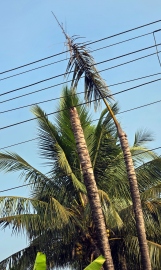
Once thriving in Sattari taluka, coconut cultivation now faces an uncertain future due to the increasing menace of wild animals and an outbreak of diseases which have been destroying coconut trees in large numbers.
As a result, coconut production in Sattari taluka has been severely affected, and coconut growers have feared that if timely and effective measures are not taken, traditional coconut culture in the region may disappear in the coming years.
According to coconut growers, effective measures are urgently required to control the menace of wild animals as well as diseases affecting coconut trees.
Sattari taluka is predominantly agriculture-based, and for several decades coconut cultivation was widely practised here. The region produced coconuts in large quantities, and many families depended on coconut farming for their livelihood.
However, the situation has now changed, with farmers shifting their focus from coconut cultivation to cashew and mango plantations. As coconut trees in traditional plantations continue to perish and no concrete remedial measures are taken, many growers have abandoned the management of these plantations. Consequently, the area under coconut cultivation in Sattari has declined sharply, directly impacting overall coconut production.
The increasing menace of monkeys and giant squirrels has become a major cause of concern for mango, cashew, and coconut growers. Large-scale damage to crops is being reported, prompting coconut growers to repeatedly demand measures to control the monkey population. However, growers allege that the government is merely delaying the issue by providing assurances instead of implementing concrete solutions.
In addition to wild animals, disease has also caused large-scale destruction of coconut trees in the taluka.
Trees that were once yielding abundant produce are particularly affected. Symptoms include drying from the crown, gradual falling of fronds, and eventual death of the entire tree. Even intervention at the final stage had failed to save the trees.
Over the past ten years, thousands of coconut trees have reportedly died due to this disease, creating a serious economic crisis for coconut growers.
Compared to a decade ago, coconut production in Sattari taluka has declined significantly. As a result, coconut prices in the market have soared, with the current rate reaching around Rs 50 per coconut. Since coconuts are an essential part of daily household consumption, the rising prices have also affected the financial management of ordinary families.
Under the government’s scheme, check dams have been constructed on several rivers in Sattari taluka to ensure water availability for irrigation. Despite this development and strong potential for coconut cultivation, the continued menace of wild animals and the spread of disease have raised fears among growers that coconut production in Sattari taluka may be completely wiped out in the coming years if immediate action is not taken.