


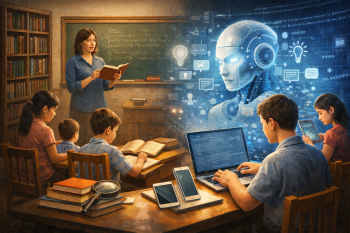
Schools and classrooms have long been symbols of hard work, rigour, and dedication. For generations, learning happened slowly and was intentionally guided by teachers, shaped by classroom discussions alongside textbooks and notes. But the current age is bringing a drastic change. The big boom the world is talking about today, Artificial Intelligence, is entering classrooms and influencing young minds.
Tanvi Parab, a librarian, has watched this change up close. “Yes, there’s change, and the number of students has reduced,” she says, reflecting on library footfall over time. “It depends on the service provided in the library. If there’s a seating arrangement, students come.” But when it comes to research, she says the culture has thinned.
“The number has reduced because everything is available digitally. They type their assignments or questions into AI tools and get them done. But then they don’t even come to cross-check the data and information they get from ChatGPT.”
Earlier, she explains, students relied heavily on reference books. Now, browsing has taken a different turn. “I have seen students who don’t pay attention to details. Simple things like identifying a book by its colour or the place where it was kept show that they don’t notice the title or the author.”
She adds thoughtfully, “Students are losing out on important aspects of their lives by not spending time in libraries.” Even fifteen minutes spent reading current affairs or magazines, she feels, could make a difference.
In classrooms, the impact is equally visible. Trupti Umarye, a higher secondary teacher in Ponda, says, “I see a huge impact of AI from this year onwards, especially now that AI tools are freely available to students.”
The difference is striking. “Students who used to struggle with PPTs and assignments earlier are now making excellent presentations. Work presented with the help of AI is totally different from what I teach in class,” Trupti claims. A poem’s analysis, she says, can suddenly appear extremely good and very well thought out.
To address this, she designs assessments such as presentations, oratory exercises, enactments, and role-plays in class to capture students’ raw understanding.
With years of teaching experience, she says she can tell the difference. “What I teach in class doesn’t match with AI’s output in the students’ work,” she explains. Sometimes the answers are polished but lack personal understanding. She believes the solution lies in balance rather than banning AI.
“Students have AI as a subject, but we as teachers aren’t aware of what they learn in those classes. This gap between teachers and students should be bridged through workshops for both teachers and students so that AI can be used more effectively.”
Vidula Desai, a high school teacher from Sattari, approaches this shift through blended teaching methods. “Since ours is a village school, students are still lagging in technology, so as a teacher, I can blend both traditional and AI-based teaching strategies,” she says.
As a language teacher, she finds that AI contributes by providing innovative ideas and helping modify lessons. She believes integration is essential. “AI should be integrated into learning. Students can make better use of it if it is used properly to enhance creativity.”
Meanwhile, students often see AI as a convenience, and sometimes a relief.
Shriya, an eighth-grader from Mapusa, has a thoughtful view of AI in education. “I don’t rely on a single source for research. I first refer to the textbook, then Google and multiple websites, and then AI to explore the topic in depth.”
For her, AI is useful when she is confused. “When I give a prompt to AI, I get everything I want. The internet and AI help me work faster.” She edits the responses before submitting assignments and still values books because they help her research more deeply and clearly. However, she admits that she sometimes uses AI as a shortcut when she feels stressed. She even uses it to create study timetables and plan her schedule during exam time.
For Siddhi, an eleventh grader in Ponda, the transition has been more direct. “When I was in school, I used Google, but now I directly turn to AI because it makes work easier, breaks things down, and helps me understand better,” she says.
She no longer visits the library for research. “I feel I have all the information at hand. AI saves time and works faster. It’s like a shortcut.”
Today, a new academic reality exists somewhere between the shelves of libraries and the glowing screens of smartphones. As educators and students adapt, teaching and learning are becoming more experimental and assisted rather than purely instructional.
However, one truth remains unchanged. As Trupti firmly asserts, “In a student-teacher relationship, there is no AI in between. And there is no AI during exams.”
Hard work and rigour may now be shared with AI, but schools remain systems of knowledge and practice. The question is no longer whether AI belongs in classrooms; it already does. The deeper question is how thoughtfully it will be used.
Cognitive psychology suggests that students grow intellectually through writing, revising, struggling through confusion, and learning to identify their own mistakes. If AI reduces drudgery, it can be helpful. But if it replaces the effort of thinking, the process that builds competence may slowly be outsourced.


