


"I travelled to space with a billion hearts with me. Sky was never the limit, not for me, not for you."
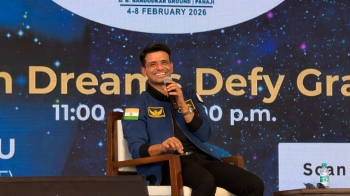
Speaking to a captivated audience on Day 3 of the Goa Book Festival 2026, Group Captain Shubhanshu Shukla, AC, Astronaut and Fighter Pilot with the Indian Air Force, offered a rare, candid glimpse into the reality of his journey aboard the Axiom-4 mission.
In a session moderated by the Director of the National Book Trust, Yuvraj Malik, Shukla moved beyond the glamour of space travel to discuss the discipline it demands, the fear it brings, and the resilience it builds. From the grueling physical demands of the Falcon 9 launch to the philosophical shifts caused by the "Overview Effect," he painted a vivid picture of life as a modern astronaut.
Unlike many who gaze at the stars from infancy, Shukla admitted that becoming an astronaut was not his childhood ambition, primarily because the pathway didn't exist.
"To be very honest, when I was your age, sitting in classrooms, I did not think that I would become an astronaut," Shukla told the students in attendance.
He noted that he hadn't even been born when Wing Commander Rakesh Sharma made history in 1984 by becoming the first Indian to travel to outer space. While he read about Sharma growing up and found the story fascinating, the gap in time and opportunity was too vast. "India did not have a human space program, so the thought that I could be an astronaut didn't occur to me."
His focus was initially on the skies, not the stars. "If I go into defense, I will become a fighter pilot. So that I became," he recalled. It was only after Prime Minister Narendra Modi’s 2018 announcement from the Red Fort on Independence Day, regarding India's flagship human spaceflight programme, that the dream crystallized. "So then this excitement came back, that maybe there is a chance."
Shukla revealed the unseen challenges preceding the launch, specifically a grueling isolation period. While astronauts typically undergo a two-week quarantine to prevent carrying infections to the Space Station’s closed environment, his team faced repeated delays.
"For some reason or another, our mission kept getting delayed," Shukla explained. "Since 1961, this was the longest unbroken quarantine for any spaceflight ever, 32 days. It was very challenging."
When launch day finally arrived, the pressure was immense. On his journey to the launch pad, Shukla turned to music to steady his nerves, specifically the track Vande Mataram from the movie Fighter.
"I played it, and by the time the song ended, I was ready to go on the mission," he said, adding that he "needed something that reminded me why I was going."
However, the moment the Falcon 9 rocket engines ignited, the sensory overload briefly wiped his mind clean. "I forgot all my training," Shukla admitted. He compared the feeling to the anxiety of an examination hall. "It was exactly like when you’ve studied, you’re prepared, but when the moment comes, the question paper comes, and everything feels blank. Everything disappears for a little while."
Once in orbit, Shukla became part of an elite group consisting of Commander Peggy Whitson from the USA, and Mission Specialists Sławosz Uznański from Poland and Tibor Kapu from Hungary. "I was Astronaut No. 634 to cross the Kármán line," he noted, referring to the internationally recognised boundary of space at 100 kilometres above Earth.
He described the profound physical shifts of life in Zero-G, such as fluid shifts causing a "puffy face" and thinning legs, as well as a temporary increase in height. However, the psychological impact, often called the Overview Effect, was far more significant.
"We think our city or school is our identity," Shukla observed. "When we move outside India, our country becomes our identity. But when we go beyond this planet, we all become humans, and the Earth is our home."
Shukla also took time to address the younger generation’s relationship with success and failure. He argued that society is adept at celebrating success but fails to teach resilience.
"I feel that we teach very well how to celebrate success, but we don't teach how to handle failures," he observed. He urged the audience to view failure as a necessary step in the learning process rather than a dead end. "Failed today? No problem, try again. I don't say 100% for anything. In this whole universe, there is nothing like that."
Concluding his address, Shukla touched upon the iconic moment when Rakesh Sharma described India from space with the phrase "Sare Jahan Se Achcha." While admitting he couldn't improve on that answer, Shukla pivoted to the future, linking the pride of space exploration to national development.
"We have set bold dreams for ourselves, including the vision of India becoming a developed nation by 2047," he stated. However, he emphasized that this is a collective burden. "But this will become possible only when each of us takes responsibility and commits to making it a reality."


