 Representative image.
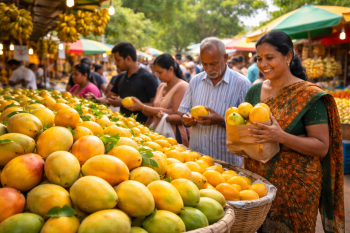
February brought sweet but surprising news for Goans. The season’s first batch of Mankurad mangoes arrived in the market, with a single mango priced at Rs 600. Despite the steep rate, mango lovers queued up to buy their first taste of the season. For many Goans, the high price did not come as a shock. They are used to paying heavily for fish, their staple food, to satisfy their taste buds. So paying Rs 7,200 for a dozen of their favourite mangoes seemed acceptable, especially as Mankurad is the most popular local variety in Goa.
Vendors in Margao said the high price was due to the fruit’s early arrival and limited supply. With demand remaining strong, sellers appeared confident and upbeat about their earnings.
Mangoes are the preferred fruit for most Indians. Often called the ‘king of fruits’, mangoes are rich in nutrients and loved for their taste. They contain vitamin C, vitamin A, folate and fibre, and are low in calories. Mangoes help boost immunity, support skin and eye health, and improve iron absorption. This is one reason the fruit holds an important place in Ayurveda. India grows hundreds of mango varieties across different regions.
Goa alone has over 80 local mango varieties. The most popular is Mankurad, followed by Alfonso, widely known as Hapus across India. Other varieties include Manga Hilario (Mangilar or Mangilal), Fernandinho (Fernandina), Xavier (Shavior), Colaco (Colas), Bishop (Bipso), Malgesh and Monserrato (Mussurat). Many of these varieties are named after Goan Catholic families who introduced and nurtured them. Manga Hilario is believed to have originated in the garden of Hilario Fernandes of Siolim, giving it its name. Monserrato de Bardez takes its name from the Bardez taluka where it originated.
After cashews and coconuts, mango occupies the largest area under fruit cultivation in the State. Goa has a long history of mango farming. The poorly coloured mango once called Malcorado by the Portuguese later became the premium Mankurad, now considered one of the tastiest varieties. It is also known as Goa Mankur, Kurad, Corado and other names, and is widely available across Goa.
Another variety, Malgesh, also known as Malgesta, Malgessa, Malgueso or Malgess, is popular in North Goa. The fruit varies in colour, size and quality. In Portuguese, Malgess means ‘difficult to digest’. Goa grows two types of Malgesh “ Khand Malgesh, which has thick skin and lower quality, and Akno Malgesh, which is considered superior.
Colaco has a distinct flavour and is tangy rather than sweet. Bishop is grown in limited areas in North Goa and is available towards the end of May. Alfonso, also known as Afons, Goa Appus or Goa Alfonso, is gradually disappearing as the Ratnagiri Alphonso has a longer shelf life. Hilario is very popular in North Goa for its sweet taste and fetches good prices. It arrives late in the season and matures till July, when most other varieties are no longer available. Monserrate is red on the outside, pulpy and sweet, and is mainly used for making jams, jellies and sweet pickles. Fernandina does not spoil easily, even during rains, and is resistant to fruit flies. Xavier is juicy and comes in both fibrous and non-fibrous types.
Mango farmers in Goa are hopeful of a strong 2026 season due to extended cool weather, which is favourable for uniform flowering. “Such climate promises for a higher yield, as compared to the previous year,” said Ashok Joshi, an award winning farmer who received Krishi Bhushan State award for 2025-26.
Many farmers and horticulturists said the flowering was healthy despite a prolonged monsoon. Although the first flowering was damaged by rain, the following winter helped the trees flower again. The second flowering occurred quickly due to lower temperatures.
“We are hoping to get better yields, at least 20 % more,” said another farmer. He added that fears of crop damage due to the extended monsoon proved unfounded. With higher supply, mango prices are expected to soften, bringing relief to consumers.
Wholesalers at Pimpalkatta in Margao, however, declined to comment on prices, saying this period is crucial for their earnings. A roadside vendor on Abade Faria Road in Margao said, “Only time will decide. Currently we will not lower our price.”