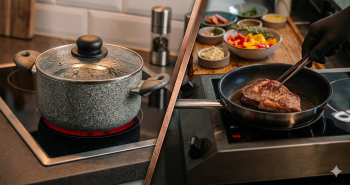
The ongoing gas shortage in India has pushed many households to rethink how they cook. With LPG cylinders becoming harder to access in some areas, electric induction cooktops are quietly finding their way into kitchens that have traditionally relied on gas. Yet, despite this shift, a persistent perception remains: that induction cooking is an “elitist” choice, meant only for affluent households.
This assumption does not hold up when examined closely. In fact, induction cooktops are not only practical but can also be more economical than LPG in the long run.
At the heart of this discussion is efficiency. When you cook using an LPG stove, a significant portion of the energy generated by the flame is lost to the surrounding air. The heat spreads beyond the base of the vessel, warming the kitchen rather than the food. Studies and practical observations suggest that only about 40“55 percent of the energy from LPG is actually used for cooking.
Induction cooktops, on the other hand, work differently. They use electromagnetic energy to directly heat the cooking vessel. This means that the heat is generated within the utensil itself rather than being transferred from an external flame. As a result, energy efficiency can reach upwards of 80“90 percent. Simply put, less energy is wasted, and more of it goes into cooking your food.
This difference in efficiency directly impacts cost.
While the upfront cost of an induction cooktop may range from Rs 1,500 to Rs 3,000 for a basic model, it is a one-time investment. Compatible cookware”such as stainless steel or cast iron utensils with a magnetic base”may add to the initial expense, but these are durable items that last for years. In many cases, households already own compatible utensils without realising it.
Now consider the recurring cost of LPG. A single cylinder in India can cost anywhere between Rs 900 and Rs 1,100, depending on subsidies and location. For an average household, one cylinder may last about a month. Over a year, this translates to roughly Rs 10,000 to Rs 12,000 spent purely on cooking fuel.
Electricity, by comparison, is often more stable in pricing. Even with an average tariff, cooking on an induction stove can turn out to be cheaper due to its higher efficiency. Boiling water, making tea, cooking rice, or preparing vegetables generally consumes less electricity than one might assume. Over time, the monthly cost of using induction can be lower or at least comparable to LPG”especially when used alongside gas rather than as a complete replacement.
Another important factor is control. Induction cooktops allow precise temperature settings. This reduces overcooking, burning, and unnecessary energy use. Faster cooking times also mean less overall power consumption. For instance, water boils significantly quicker on an induction stove than on a gas flame, saving both time and energy.
The perception of induction as “elitist” likely comes from its association with modern kitchens and urban lifestyles. However, this overlooks a key reality: affordability is not just about initial cost, but about long-term savings. A product that reduces recurring expenses is, by definition, economical.
There are also indirect savings to consider. Induction cooking produces less ambient heat, which can make kitchens more comfortable”especially in warmer regions. It also reduces soot and residue, cutting down on cleaning time and associated costs. Additionally, the absence of an open flame lowers the risk of accidental fires, adding a layer of safety that is hard to quantify but important nonetheless.
It is worth noting that induction cooking does depend on a stable electricity supply, which may not be consistent in all areas. However, with improving infrastructure and increasing electrification across India, this limitation is gradually becoming less significant.
Ultimately, the idea that induction cooktops are only for the wealthy is more perception than reality. When evaluated in terms of efficiency, running cost, and long-term value, induction cooking emerges as a practical and economical choice for a wide range of households.