


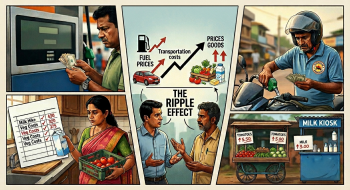
Yet another petrol price hike within ten days, coupled with raised rates for essential commodities such as milk, has left many Goans limiting their expenses and keeping a check on their monthly budget. With fuel prices going up, so are transportation costs, ultimately affecting various sectors. Thus, the prices of goods and services are being pushed up, adding to the burden on households already struggling with a high cost of living.
Petrol price hike
Petrol prices continue to climb steadily across the country. In several cities, including Hyderabad and Kolkata, fuel prices have crossed the Rs 100 per litre mark, intensifying concerns over how much more consumers may have to spend in the months ahead. For many families, the increase extends beyond fuel bills, influencing the cost of everyday necessities. Purchases have to be monitored and unnecessary spending avoided. As household budgets come under increasing pressure, consumers are becoming more selective about where and how they spend their money. While essentials remain unavoidable, major purchases are often the first to be reconsidered by the common man. As households become more cautious with their finances, concerns are also growing about the impact on larger purchases such as vehicles.
Car price revision
Commenting on Maruti Suzuki’s recent price revision, Daulat Valvaikar, Assistant Manager (Training & Development) at a local automobile showroom, said the increase comes at a time when consumers are already exercising caution in their spending. “While it is difficult to say whether rising fuel costs alone will affect vehicle sales, overall demand may slow down as people become more mindful of major purchases,” he observed. Drawing parallels with the uncertainty witnessed during the Covid period, he added it would be wise to be patient about the whole scenario. Sudhesh Dhargalkar, manager of yet another car showroom, remarked how the fuel hike would ultimately result in an increase in prices of various other goods. “If petrol price rises, that means all other prices rise. While we haven’t been hit by it, it is on the way,” he stated.
Livelihoods affected
For those whose livelihoods depend directly on fuel, the impact has been grave. “We have to continue working despite the hike; otherwise, we won’t have enough to eat,” said Raju Moraskar of the Curchorem Pilots’ Association. Motorcycle pilots, who spend a large part of their earnings on petrol, are among those feeling the pressure most severely. “We would like to request the government to consider incentives or subsidies for us. Any support would be a great help,” he added.
Essential commodities
It is not just the automobiles or pilots facing the pinch. Essential commodities such as milk and vegetables are also under financial strain. A vegetable vendor from Panjim remarked on the rising prices of certain vegetables. “The prices of tomatoes and beans have grown; the other vegetables are the same. Not much has changed as of yet,” he mentioned.
While Goa Dairy (one among the many dairy companies) has announced revised prices effective from May 25, milk vendors across the state express their worry. “With your Rs 8000 salary, what will you do: drink milk, pay your child’s fees, or pay your rent? The middle-class working man suffers the most. The whole problem has started since the petrol and diesel prices have increased,” a milk vendor shared. Further remarking on the exorbitant rise in prices, he expressed his concerns about how bleak the future looked for the Goans. “If this is the state now, how will the picture look in the future?” he questioned.
His question indeed raises a cause for concern. The dreams of the working class are ultimately buried under rising prices and inflation. As prices continue to rise across sectors, the impact is being felt by everyone, from vendors and workers to families managing household expenses. Whether it is fuel, milk, or vegetables, exorbitant prices are steadily increasing the cost of everyday life and, in turn, influencing daily decisions, household budgets, and plans. While businesses and consumers adapt as best they can. While there is not much for people to do but adjust their spending and tighten their budgets by avoiding unnecessary spending, they hope that things will stabilise in the future and bring them some relief.


