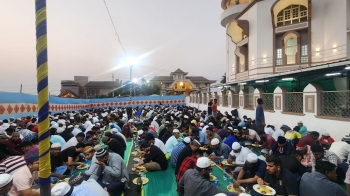
The sound of quiet prayer fills the room. Families gather around the table to pause and reflect as the aroma of food slowly spreads through the house. After a day of discipline, devotion, and faith, Iftar is a sweet way to end the fast. Tradition intertwines with ritual as the fast is broken with a date and a glass of water after sunset.
Personal meaning
For the Muslim community, it carries personal meaning. For some, it is a special ritual they follow each year. For others, it is a cherished memory shared with loved ones. And for those living far from home, it can be a reminder of what they miss most. Beyond the food, it is a time for reflection and prayer, for seeking forgiveness, abstaining from wrongdoing, and pausing to consider one’s actions during Ramadan.
Sacred month
The ninth month of the Islamic calendar is observed by Muslims worldwide as a period of fasting, communal prayer, and introspection. It is also believed to be the month when the Quran was revealed to the Prophet Muhammad. Suhoor, the pre-dawn meal taken before the Fajr prayer, sustains energy for the day ahead. Iftar, observed at sunset during Maghrib, marks the breaking of the fast, traditionally with dates and water.
Simple essence
While Iftar dishes may vary across households, the faith and the dates remain constant. Ashfaaq Khan, who oversees a bustling food stall, says the essence of the fast is not about grandeur. “You can break the fast with even salt and water. Most of us break our fast with water and dates. You can break the fast with biryani or with a date. It depends on one’s financial status,” he explains, as customers continue to stream in.
Childhood memory
His favourite childhood memory is simple and heartfelt. “Amma aaj kya banayegi?” he recalls thinking every evening, smiling widely as the two boys helping him at the stall share a laugh. For him, it is a moment always tied to home, anticipation, and the comfort of his mother’s cooking.
Community spirit
Community spirit lies at the heart of Iftar. Iqbal Mohideen, who prepares meals for large gatherings, says, “We have about 600 to 750 people being fed, thus bringing the community together.” Tables are often laden with dates, fruits, chaats, kheema, and more. The spread may be lavish, but what truly stands out is the sense of unity as people sit side by side to break their fast.
Ramadan wonder
Kulsum Khan recalls a Ramadan wonder. One evening, her family reached home just ten minutes before Iftar with only some samosas and watermelon from the market. They managed with that and planned to order dinner, but for some reason could not. As hunger grew and they decided to cook something simple, the doorbell rang. A man stood outside with a parcel of biryani that they had not ordered. “For me, it felt like a true Ramadan miracle,” she says. Moments like these strengthen belief and remind one how faith and devotion can manifest in unexpected ways.
Home longing
For many, Iftar is about praying together and gathering around the table to enjoy the delicacies. For those living away from home, however, it often means missing ‘Maa ke haath ka khana’. Sabrin Sheikh, now based in the UAE, reflects on how much has changed. “For me, it was not only about the lavish food spread my mother made, but also about the love and warmth poured into it. Now it is often just cold takeout,” she says. She remembers how her mother would gently wake her for morning prayers. Today, it is a jarring alarm clock that replaces that loving voice.
Changing times
Times have changed. Warm home-cooked meals are sometimes replaced by quick takeout. A table once filled with family may now see someone observing Iftar alone. Many grown-up adults now speak of choosing healthier meals and spending more time in prayer.
True essence
However, even though there are extravagant spreads and aesthetic celebrations across the world, for someone truly observing the fast, the essence remains elsewhere. It lies in the quiet moments of prayer, in seeking forgiveness, and in building a deeper connection with the Creator.