


The attention to research usually comes from academically inclined persons who have their own personal interests or those who have some stake in the outcomes of research. Hence, such studies are rarely of concern to the general population.
However, lately there has been one research study grabbing attention as it reveals something about us, in particular, our intelligence as we conventionally know it. It is called the Reverse Flynn Effect.
Flynn Effect
In his seminal work, psychologist James Flynn documented the steady rise of IQ scores in standardised IQ tests, right from the 1900s, with each generation scoring around 13“15 points higher than the previous generation. This effect was called the Flynn Effect. The generation gap, in a way, was a reflection of the rising intellectual capacities of the new young generation.
In fact, creative genius and innovations brought on by human thinking and know-how have never been so advanced in comparison to previous centuries, thanks to the onset of digital technology. The Flynn Effect has been demonstrated in over 30 countries and has highlighted the importance of environmental factors such as nutrition, health, education, technology and the like in influencing intelligence, thus even undermining the role of genetics.
Reverse Flynn Effect
Now, what is the Reverse Flynn Effect? Studies in developed countries have started showing a trend of a gradual drop in IQ scores for the first time in 15 years. Research from the USA, UK and Europe indicates that among active cognitive abilities there is a steady drop in attention, maths, reasoning, memory, reading, vocabulary and problem-solving skills among emerging and young adults.
There is a possibility that Generation Z (born between 1997 and 2012) may actually have, on average, a lower IQ score than previous generations. This startling trend is called the Reverse Flynn Effect.
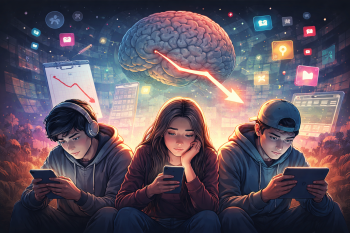
Dr Jared Horvath, an American neuroscientist, has linked the decline to screen time and the adoption of tech devices in academics where students are concerned. Young minds spend most of their time on screens, not necessarily on academic activities but multitasking, leading to distraction or doomscrolling.
Digital behaviour has reduced the ability to deeply process information. This is evident in the increase in AI tools. The shortcut to any problem is to go online and seek answers. We have to remember that artificial intelligence may not necessarily give you the best answer but rather one that is based on an algorithm that, in turn, is manipulated by market forces.
So, learning from devices is not necessarily objective, even for young minds. This is why many countries around the globe have come up with policies imposing limits where the usage of devices, including screen time and social media, is concerned for young children.
A wake-up call
How does all this affect you and me? We already see the signs of the Reverse Flynn Effect right in our homes. It is easy to Google for ready answers or use ChatGPT for better reports. Assignments and projects are so perfect that sometimes it is clear such quality of work is beyond the capacity of the person taking credit for it.
In fact, what is clear is that there is a loss of personal social skills, shorter attention spans, an inability to deeply process information and glimpses of weaker memory among chronic mobile users. Teachers across classrooms will tell you that students are not just sleepy right at the beginning of the day, but they can barely hold a discussion without the support of their gadget.
No device or digital service is inherently bad in itself. They do much to cover the gaps that we have in knowledge and understanding whilst saving time. The problem lies in the fact that we don’t want to think if we can get the ready answer. We don’t want to write a draft and revise a document if it can be generated directly.
While it seems fascinating at first to get things done in seconds, we are, in effect, slowing our own capacity to think and killing our brain cells. If we are unable to regulate our own thinking and intellectual capacity, then the Reverse Flynn Effect is a wake-up call to all, lest our very own evolution itself gets reversed.
(Associate Professor and Head of Department of Psychology at St. Xavier’s College, Mapusa)


