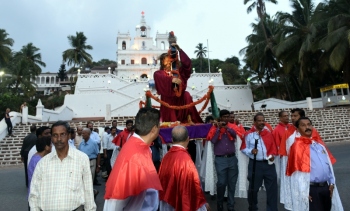
Lent has long been a season of quiet discipline, reflection, and deeply rooted tradition. Even today, this 40-day period continues to hold spiritual significance for the faithful, observed through prayer, fasting, and acts of sacrifice. While practices may have evolved across generations, the essence of Lent, introspection, repentance, and renewal, remains unchanged.
Change of mind and heart
Within the Church, Lent is a period of preparation for Easter, mirroring Jesus’ forty days in the desert and his journey toward his passion, death, and resurrection. Fr Cipriano D’Silva, Parish Priest of Our Lady of Immaculate Conception Church, Panaji, explains, “Lent is a time of change of mind and heart or metanoia; a time when [individuals] look at themselves and try to work on certain aspects of their lives like sin or shortcomings; it is the journey of the soul and growth in spiritual life.”
It is a season rooted in the three pillars of prayer, fasting, and almsgiving, calling for both reflection and action.
Beginning of Lent in Goa
In Goa, Lent is preceded by the famous Carnival, first traced back to the mid 18th century as ‘Entrudo’ by the Portuguese. Fr Cipriano explains the origin of the word ‘Carnival’, he says “the word ‘carnival’ comes from the Latin words caro or carn meaning ‘flesh’ and levare meaning ‘put away’”, nodding to dietary restrictions. Carnival features vibrant floats and high-energy street parties, normally lasting 3 to 5 days, ending on ‘Shrove Tuesday’ or the Tuesday before Ash Wednesday.
Evolving observances
Commencing from Ash Wednesday, the lay faithful take up various spiritual practices during the forty days. Fr Loddy Pires, Director of the Our Lady of Fatima Shrine, Don Bosco, Panaji, notes changes in observances, “While the Church’s prescription for Lenten observances has remained the same, it is not as rigorous as before and has become lenient in terms of restrictions or fasts that the faithful maintain. People should take up acts of sacrifice, penance, and almsgiving to truly live out the meaning of Lent.”
Observances have evolved, and youth often adapt practices to their way of life, while the older generation continues to follow more formal traditions. Goa also stands out for its distinct Lenten expressions, spiritual pilgrimages, retreats, processions, and sacred music.
Santachem Pursanv
The village of Goa Velha features one of the most unique Lenten practices, the Santachem Pursanv or Procession of Saints, which takes place on the Monday after the 5th Sunday of Lent. Fr Reuel Fernandes, Parish Priest of St Andrew’s Church, describes the preparation, “Our preparation begins a month in advance. We prepare the statues of the saints, which are dressed in a special wing of the Church; there are around 31 saints and one veil of Veronica.”
Originating from the Franciscan Order in the mid 17th century, with over 60 saints, many of which are now degraded or lost, the latest addition is St Joseph Vaz.
Fr Reuel details the event, “We begin with a mass at 4 that is presided over by an invited priest. After the mass, the procession begins, and each saint is brought before the altar, and a short commentary on their life is given. They are then taken in a procession around the village. On returning, a sermon is preached by the priest, and the saints are placed for veneration. Veneration of the saints is open for three days after the Santachem Pursanv.”
Devotees across faiths participate, many seeking blessings by walking beneath the saints’ palanquins.
Santos Passos
Across the rest of Goa, the Santos Passos or ‘Holy Steps’ began around the 15th century through the efforts of the Dutch Jesuit priest Fr Gaspar Barzeo. Certain parishes conduct the Santos Passos either on a particular Sunday in Lent or throughout the Sundays of the season.
This tradition represents Christ’s Passion, especially his journey to Calvary. Tableaus depict key moments, while confraria members carry the life-size statue of Jesus with the Cross, halting three times to symbolise his falls. The statue of Our Lady of Sorrows joins the procession, representing Jesus meeting his mother. In some instances, a young girl sings the Song of Veronica, depicting the moment she wipes the face of Christ.
Sacred music
Prayers and chants during the Santos Passos are often interspersed with motets, Goa’s distinctive Lenten sacred music. Emerging in the mid-19th century, these choral compositions were originally sung in Latin and later translated into Konkani after Vatican II. They remain central to liturgical services during Lent, especially during the Santos Passos and the Holy Triduum.
Bhavartachi Yatra
Another significant practice is the Bhavartachi Yatra, a walking pilgrimage to Sancoale organised by the Archdiocese of Goa and Daman. Held on the first Sunday of Lent, it draws thousands from across the state and beyond.
The pilgrimage begins at 2 am from five centres, Bambolim, Neura, Cansaulim, Verna, and Vasco, and concludes at the façade of the old Sancoale Church with a Eucharistic celebration. Pilgrims walk nearly 10 kilometres to attend the dawn mass, usually celebrated by Archbishop Filipe Neri Cardinal Ferrao. Devotees across faiths and age groups take part in both the journey and the celebration.
Key Lenten observances
Practices like the Stations of the Cross and observances of key days, Ash Wednesday, Palm Sunday, and the Holy Triduum, continue to draw strong participation. Fr Cipriano notes, “We had 6 masses this year, three in Konkani, 2 in English, and 1 in Hindi, and all were attended by large crowds.”
The Stations of the Cross, typically held on Fridays, remain a deeply engaging experience for families. Livelyn Manuel, a mother of four from Colvale, shares, “The Stations of the Cross by the Alverno Friars in Guirim has been a family tradition for nearly 18 years. We walk up Monte de Guirim reflecting on Jesus’ steps, and it’s always a time of spiritual renewal. My children have grown to look forward to it each year.”
Message from the clergy
As Lent continues over the next few days, culminating with Easter on April 5, the message from the clergy remains consistent. “Conversion of heart towards love and sacrifice should last beyond just Lent and should persist even after that,” says Fr Loddy, while Fr Cipriano adds that the real fast is from criticising others, urging people to reconcile.