


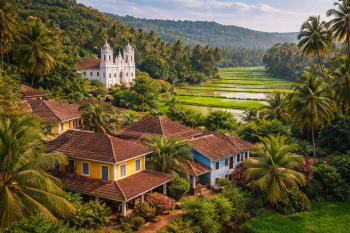
Goa has over 400 villages with names that are carved out of history and much more. Aldona, locally pronounced Oidone, is a scenic village in Bardez taluka, famous for its heritage homes. Its pre-Portuguese name was Haldona/Haledone, which is derived from Hal (plough) or Haldi (turmeric), a key historical crop, meaning village of the plough or place of turmeric/ploughing, highlighting its prosperous farming heritage. Anjuna (Konkani: Honjunnem) is a vibrant coastal village in Bardez taluka, famed for Anjuna Beach, its famous Wednesday flea market, 1960s hippie scene, and dramatic cliffs. Its name derives from Arabic Hanjuman/Anjuman (merchant guild), reflecting its medieval role as a bustling Arab-influenced trading port before the Portuguese arrival. Some historians suggest that Arpora may have evolved from the Sanskritised name Haripur; Hari, a name of Vishnu, and pur, meaning village, which gradually changed through Konkani usage and Portuguese influence. Another explanation comes from Konkani, where Ar refers to water channels or streams and Pora means settlement or inhabited place. As the village is located near inland waterways and the backwaters of Baga Creek, the name may describe a settlement situated near a water channel.
One common theory links Assagao to Ashram-gaon (ashra: hermitage and gaon: village), meaning village of hermitages. The area was once known for spiritual settlements and temples, and the name may have gradually shortened and transformed through local pronunciation and colonial spelling into Assagao. Also known as Fullyanchem Gaon or the Flower Village, the villagers here used to grow marigold flowers to sell in the famous Mapusa market. The name Assonora likely evolved from older Konkani or Sanskrit roots. One theory connects it to Asan, a locally found tree (Terminalia elliptica), and ora, meaning locality, suggesting a place of Asan trees. Another view links it to a clan or settler’s name combined with a term for settlement or cultivated land. Agonda is a small fishing village located in the Canacona taluka, and its name is likely from Sanskrit or Konkani, possibly from Aghanda, meaning a place with hills and water, reflecting the village’s coastal and gently hilly landscape. Adcolna is situated in Ponda taluka, and the name Adcolna is likely from “Ad,” meaning beginning or upper, and Colna, meaning village, settlement, or waterway, together signifying a settlement at the upper end or near water, reflecting its riverside and fertile location.
Trade, language and colonial history
Arvalem (Harvalem) in North Goa, near Sanquelim, is renowned for its Arvalem Waterfall and ancient rock-cut Pandava Caves, which date back to the 6th century. Built by Buddhist monks for meditation, the caves are also linked to the legend of the Pandavas and Draupadi’s exile. Anjadiva Island is located in the Arabian Sea, near the Canacona seashore. Ange means near or adjacent in Konkani/Sanskrit, and Diva means island, so Angediva literally means nearby island, reflecting its coastal position. The Portuguese built Anjediva Fort to strengthen their military presence and support trade with Greek, Arab, Egyptian, and Portuguese merchants, and established the Church of Our Lady of Springs in 1502”the oldest Roman Catholic Church in Asia”and the now-ruined Chapel of St. Francis D’Assisi.
Legends, faith and cultural identity
Amona, a village in North Goa’s Bicholim taluka, has roots tied to ancient dynasties, Aryan settlers, and the Marathas, with its temples revealing a rich, early military culture, and an ancient centre for trade and commerce with a lot of cultivated fertile land and alluvial banks of the Mhadei. Amon means peaceful riverside settlement. Ashwem/Ashvem is a tranquil, scenic village and beach destination located within the Mandrem coastal area. Some suggest Ashvem comes from Ashwa, the Sanskrit word for horse, possibly indicating that the area was historically associated with horse breeding, stables, or cavalry routes. Located on the border of Quepem taluka, Assolda likely gets its name from hilly terrain, fertile land, or nearby rivers. An ancient Goan village, it existed before the Kadamba era and was one of 22 villages in Chandrawadi under the Bhoja kings.
Baga, a popular coastal village in North Goa known for its nightlife, likely gets its name from the Konkani word for small tide or estuary, referring to the nearby Baga River and the village’s sandy shoreline and backwaters. Bambolim likely originates from Konkani or Sanskrit terms describing bamboo groves or dense vegetation, which may have inspired the name, later modified under Portuguese influence. Banastarim likely originates from Konkani or Sanskrit, meaning a settlement near or within a forest, later modified under Portuguese influence. The name is also tied to the history of local communities, with some historical contexts in Goa connecting place names to local communities like the Bhandaris. The region was known for the Fort of São Tiago of Banastarim, which was conquered by Afonso de Albuquerque in 1512 after the initial 1510 campaigns. Bastora, also known as Bastodem, is a village on the outskirts of Mapusa believed to have existed during the rule of the Kadamba and Vijayanagara dynasties. Its name likely derives from Konkani or Sanskrit, referring to fertile land or a local settlement.
Batim is a village situated in the Tiswadi taluka. It derives its name from Baá¹ or Bat, meaning road or path in Sanskrit/Konkani, with the suffix “-im” denoting a place or settlement, suggesting a village historically situated along a major route connecting Panaji to other parts of Goa. Benaulim, also called Banahalli or Banavalli, derives from the Sanskrit meaning village of the arrow, linked to the legend of Lord Parashurama, who shot an arrow from the Western Ghats to reclaim land, landing at this village in Goa. Betalbatim or Betpatte got its name from the erstwhile presiding deity of the village, the demon-god Betal. Bicholim derives its name from the local Konkani term Divchali/Dicholi. It is believed to stem from Visolm, signifying a place where poisonous snakes or plants were once prevalent, or from Bish and Lim, referring to the two streams (confluence of rivers) in the area.
To be continued...


