Some moments don’t arrive with noise, yet leave behind an echo strong enough to stay for years. Moments that do not ask for attention, but quietly transform the way we see who we are. Moments when time does not move forward, but gently turns back, allowing a forgotten world to breathe again. Randne Pol was one such moment.
On April 19, the Tilamol Parish chose to do something rare: they chose not to move ahead, but to return. What they organised was not just an event, but a deeply intentional step towards reliving a way of life that once defined Goa”a way of life that had not disappeared, but had slowly slipped out of practice. This was not about showcasing tradition; it was about living it again.
Twelve wards of Tilamol parish came together as storytellers of their own heritage. Days before the event, and often through long nights, they worked tirelessly, shaping mud stoves by hand, gathering firewood, and building kitchens from scratch. These were not replicas designed for display; they were real, functional spaces built with effort, memory, and pride. Each ward brought something unique, yet all were bound by one shared purpose: to bring back what had quietly faded.
By 7 am, as the first light settled over Tilamol, the village was already awake. The kitchens came alive, not with the sound of modern appliances, but with the crackle of firewood, the rhythm of grinding stones, and the energy of something authentic unfolding. There was no gas, no mixer, and no shortcuts. Everything was done manually, just as it once was. Spices were ground by hand, coconut was scraped the traditional way, and every step of cooking demanded time, patience, and skill. It was not hurried; it was intentional.
The scale and spirit of Randne Pol were further strengthened by a distinguished panel of judges, each deeply rooted in Goa’s heritage. The Randne Pol (traditional kitchen setup) competition was judged by Victor Hugo Gomes, renowned for his work in preserving Goan heritage through museums like Goa Chitra, and Dr Maendra Jocelino Araujo Alvares, the creator of Ancestral Goa (Big Foot). The traditional cooking competition was judged by Guilermo Da Gama, a hospitality professional and academician, and Maureen Jocelyn Fernandes, an experienced culinary educator.
As the hours passed, what started as preparation transformed into a celebration that felt less like an event and more like a feast. The air is filled with the rich, familiar aromas of traditional Goan dishes rarely experienced today in their true form. Dishes like soji, dried fish kismur, and other age-old preparations were cooked over open flames, carrying flavours that cannot be recreated through modern methods.
But it wasn’t just the food that made it special; it was the feeling.
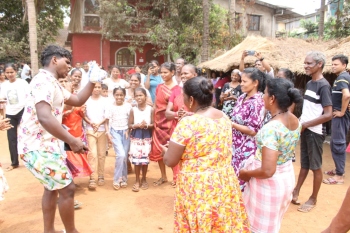
People gathered to experience, not just to watch. They walked through each ward, witnessing a way of life that many had only heard about. Elders returned to something deeply familiar, while the younger generation encountered the roots of their identity. There was no sense of rush or separation. It felt like a community coming together to reconnect.
Because Randne Pol was never about who did it best, it was about doing it together.
Each of the twelve wards created something extraordinary because they embraced authenticity. The kitchens, though simple and raw, carried a beauty that modern spaces often lack. Every detail, from the placement of utensils to the method of cooking, reflected a deep respect for tradition. Behind it all was a visible, heartfelt effort. People gave their time and energy to something that mattered beyond the event itself.
The purpose was clear: this was a powerful step towards bringing a way of life back into the present. It was a reminder that culture does not survive on its own; it needs to be lived. Randne Pol proved that Goa has not forgotten. Its people still remember how to build and cook without dependency on modern convenience. The knowledge is still there, quietly preserved in homes and stories. What had changed was not memory, but lifestyle, and all it needed was a moment like this to come alive again.
Amidst the remarkable efforts of all twelve wards, it was Nirmalgara Ward that emerged as the winner, reflecting exceptional dedication and attention to detail. Yet, beyond the result, what stood out was the collective spirit, where every ward contributed to a shared cultural revival.
In a world that constantly pushes forward, this was a reminder that sometimes the most meaningful progress lies in looking back. In the quiet glow of firewood and the taste of food made with patience, Goa found something it had not lost, just something it had stopped living. And on that day, in Tilamol, it lived again.