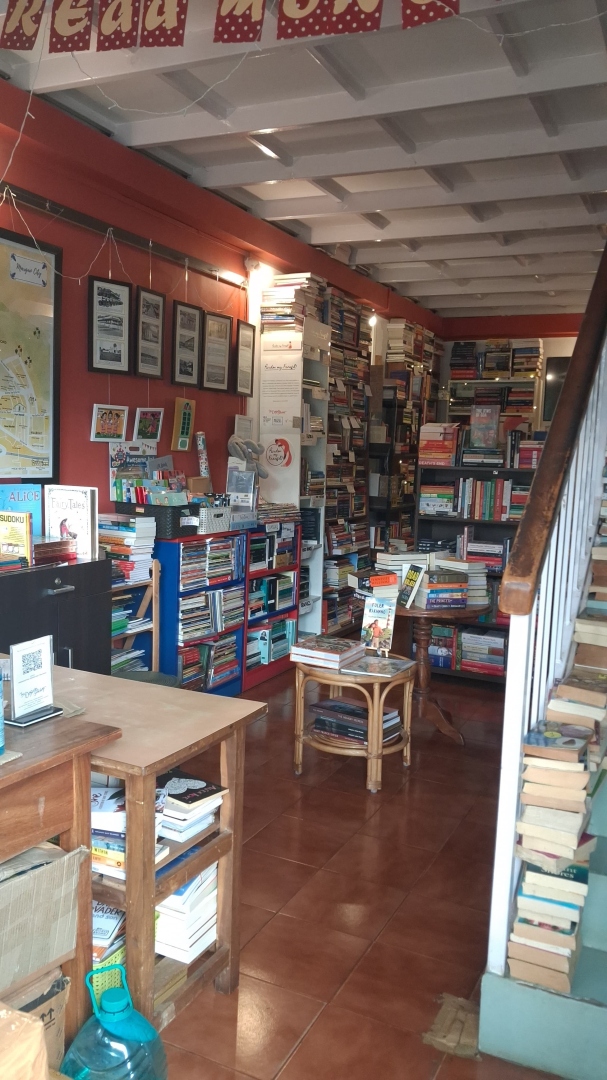
The Dogears Bookshop.
PANAJI
There is something quietly radical about walking into a bookstore with no list, no algorithm nudging you. You run your fingers along a shelf, pull something out, read the first page, and sometimes you pause for a moment. That is the promise of a good independent bookstore. It does not sell you a book; it introduces you to one.
On World Book Day, as conversations around reading often drift towards numbers, declining attention spans, and digital shifts, it feels necessary to step inside these spaces. To listen to the people who keep them alive. Across Goa, three independent bookstores offer a glimpse into what it means to build, sustain, and believe in a space for books today.
That Book Store, Porvorim
Back in 2016, when Barkha Sharda and her partner Chitrang began frequenting bookstores in Panaji, they noticed the absence of illustrated picture books that were not strictly for children. “It was only a dream,” Barkha says. “Someday, when we have the time, we might open a bookstore like that.”
COVID, as it turned out, gave them the pause they needed. Barkha had already been micro-reviewing picture books on Instagram, and when her posts gained traction, they took the leap. That Book Store is now in its fourth home, moving from markets with boxes of books to Altinho, Panaji, then Defence Colony, Porvorim, and now a more spacious setting in Socorro. But what has stayed constant is an insistence on curation over commerce.
Barkha hand-picks every single book. Translated works by women, queer and minority authors, and postcolonial voices sit alongside an extensive picture book collection that Barkha recommends to every customer, regardless of age. The store runs a monthly thematic book club, covering South Asian women’s writing, grief, poetry, and memory, and even hosts book launches. On World Book Day, it is hosting the first adult picture book club of its kind. Barkha remains firm that the hunger for stories has not disappeared: “The sheer number of people in the world has also increased. There’s enough pie for everyone here.”
The Dogears Bookshop, Margao
Leonard Fernandes and Queenie Rodrigues began Dogears almost by accident when a space became vacant in the same building as their publishing house. What started as a shop for children’s books and books on Goa has since grown into what sociologist Ray Oldenburg would recognise as a “third space”, defined neither by home nor work, but by community. “Placing a book in the hands of a reader and seeing them smile with satisfaction is what motivates us to continue another day,” says Leonard. Dogears has a clear philosophy: books should be available for serendipitous discovery. Their Goa section is notably large, and in terms of collections, they stock books that experiment with genre, challenge the reader, and push the boundaries of craft.
The store hosted over 50 events last year. Leonard is optimistic about the industry, noting that the ill effects of digital obsession are becoming better understood. “People are looking to go out and meet people, and bookshops are one place where this can happen.” The larger shift, he notes, is not in what people read but in how they engage, looking for experiences that go beyond mere transactions.
Literati Bookshop, Candolim
When Diviya Kapur started Literati, not everyone was hopeful it would last. Last November, the bookstore turned 20. Literati built its collection by listening: “Our readers have indicated what they would like to read. That’s how we built up our curation.” The result is a store that tilts towards literature, biography, and non-fiction, alongside a dedicated Goa section that draws both residents and travellers. Her events have their own reputation. Amitav Ghosh drew more than 150 people, and an evening for TM Krishna’s book on the Constitution was houseful. She also speaks of the privilege of hosting intimate gatherings, like the launch of Gautamiputra Kamble’s translated Marathi novel. “I feel privileged to have had it, because we are not exposed to that kind of literature,” Diviya says. Her book club also runs on a hybrid model begun during COVID, remaining accessible for those who cannot attend in person.
On digital reading, she does not see it as a bad thing. “It increases the reading audience in some ways,” she says. She believes a growing population and the presence of writers in Goa point towards a space that is evolving, not disappearing. “If it replaced the physical book, it would become a problem, but I do not think that will ever happen.”
Three bookstores, three different stories, one philosophy: to hold space for stories, for people, for conversations that do not always have a place elsewhere. In the right hands, books do not die. Neither does the culture around them. Independent Bookstore Day falls on April 26 this year—a timely nudge, if you needed one. Walk into one of the stores without a list. Let something find you. These stores have spent years making sure it will.