


For centuries, Goan cashew feni has been a spirit deeply tied to the earth, a vibrant, unrefined distillation of local culture, often misunderstood beyond the state's borders. But today, a quiet revolution is resting in wooden barrels, waiting to change the world's mind.
Award-winning cashew spirit brand Sentari has just secured its latest international triumph at the prestigious London Spirits Competition 2026. Following an early benchmark set by their Gold Medal win in 2025 for the Sentari Limited Edition, the brand has returned to claim a Gold Medal for Sentari NILA and a Silver Medal for Sentari BHUMI. Yet, behind the glitz of international accolades lies a remarkably grounded story of a pandemic experiment, a tyre retreading business, and a founder who simply wanted to give Goa's indigenous spirit the respect it deserves.
The unlikely distiller
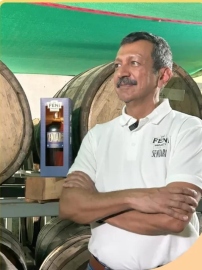
Sentari Founder Karun Sanghi is the first to admit he is an unlikely distiller. With no background in alcohol or the hospitality industry, his day job is running a tyre retreading business. But when the world ground to a halt during the COVID-19 pandemic, Sanghi found himself spending more time at his home in Goa.
"Feni started as a Covid project," Sanghi reflects. Introduced to the concept of barrel-aged feni by an acquaintance, he was handed a single bottle and a vague promise that they should "do something with this." When those plans stalled, Sanghi took a leap of faith. He bought 10,000 litres of cashew spirit sourced from the Sattari region, purchased an assortment of wooden barrels, and enlisted the help of two staff members from his retreading office.
"When I started, everyone thought I was an idiot," he laughs. "They said it makes no sense. Why would you lock money in barrels for three years without knowing the outcome? People just laughed at the idea."
But Sanghi, who has been traveling to Goa since the late 1980s, recognised something others didn't: feni was terribly underrated.
Uncorking the misconceptions
For decades, feni has been shackled by misconceptions. Outside of Goa, particularly in metropolitan hubs like Mumbai, it carries the unfair stigma of a harsh country liquor.
"Everyone I know in Mumbai is like, 'Oh, I don't drink feni... my wife won't let me sleep in the bed if I drink feni.' All these stories that you hear," Sanghi explains. "Real feni has none of that baggage, but the misconceptions are overpowering."
Breaking that stigma proved to be Sentari’s steepest uphill climb. In the early days, Sanghi would walk into liquor shops with a bottle of his barrel-aged spirit. He was met with skepticism: “Rs 1850 for feni, and you're not even Goan?” If he couldn't convince the store owner to open the bottle and take a sip, he was shown the door. But when he did manage to pour a glass, the reaction was almost always the same.
"The most common reaction was, 'This is not what I thought'," Sanghi notes. "Everything comes down to getting people to taste it. Once they taste it, things change. Even today, all I tell people is: leave all your misconceptions or ideas of feni aside for a minute."
The alchemy of Nila and Bhumi
What happens inside Sentari's barrels is a transformative softening. The raw, pungent edges of traditional feni mellow out, giving way to a spirit that can be discussed with the same reverence as a fine whisky or an aged rum. The colour deepens into a warm amber, and the nose develops inviting notes of caramel and vanilla.
Sentari’s current award-winning expressions are a testament to this patience. Sentari NILA, aged for around three years, offers a gentle entry with caramel notes. Sentari BHUMI, aged for four years with a slightly higher alcohol percentage, brings forward deeper spice notes and a smooth finish.
"It’s like comparing two whiskies," Sanghi says of the two variants. "What's the difference between Jameson and Black Label? Each of them has some subtleties. There's no clear right or wrong answer; it's just about your personal taste."
By refusing to replicate batches exactly, instead relying on the unique interactions between specific barrels and the passage of time, Sentari ensures that every bottle is a living, breathing expression of that particular season.
A place on the top shelf
Winning at the London Spirits Competition, a platform that rigorously evaluates quality, value, and packaging, is a profound validation of Sanghi's original vision. But for Sentari, the medals are merely stepping stones toward a much larger cultural shift.
Sanghi looks to the trajectory of global spirits for inspiration. "When I went to college in the US, you drank tequila just to get drunk. It was horrible stuff," he recalls. "In some ways, feni has been that. The bigger question is, how do you take something like this forward globally? How do you make cashew spirit the next Mezcal?"
He envisions a future where feni is recognised as a premium sipping spirit, proudly featured on high-end restaurant menus alongside single malts and craft gins.
"I’d like to see menus with ten different fenis," he shares, his vision clear. "Someone walks in and says, 'I’ll have a Sentari,' or they discuss the subtleties of a Sattari feni versus one from Canacona. That’s when it feels like it’s arrived."
A rising tide: Uplifting the ecosystem
For Sanghi, the endgame isn’t about Sentari monopolising the market or scaling into millions of bottles. True success, he believes, lies in uplifting the entire ecosystem of Goa's heritage spirits.
"If multiple cashew spirits exist and people start choosing and discussing them, then the category is moving," Sanghi emphasises. He envisions a rising tide that lifts all boats, in which diverse, high-quality feni brands foster a culture of tasting, comparison, and appreciation. "That’s when value and perception start to rise."


