


As the world observes International Workers’ Day, the sun beats down mercilessly on Goa. While May Day is traditionally a time to celebrate the rights and dignity of the working class, a starkly different reality unfolds on the sun-baked streets of the State.
For the thousands of outdoor and daily wage workers who keep Goa functioning, summer is not a season of beachside retreats, but a grueling test of physical endurance against soaring temperatures and stifling humidity.
THE BATTLE AGAINST HEAT
Look closely at any busy Goan intersection or marketplace, and the struggle is highly visible. Laxmi, a vendor selling fruits and vegetables in the bustling Mapusa market, embodies this daily battle. Sitting huddled under the meager shade of a solitary umbrella, she tries to keep both her produce and herself from wilting in the severe afternoon heat.
"I get up early in the morning, and my umbrella is my roof for the entire day until the evening," Laxmi shares, adjusting her makeshift canopy. "Whether weathering the scorching heat or the sudden rain, that remains our only shade. I just wish we had a proper, covered place to sit."
A little further away, traffic police direct the chaotic flow of vehicles under the relentless sun, often lacking adequate protective gear. A local traffic policeman points out that the infrastructure meant to provide relief often does the exact opposite. "The traffic cubicles provided to us are made of tin. In this sun, they turn into ovens," he explains. "Instead of using them, we prefer finding a spot of shade under a tree or a nearby shop awning to stand in while taking a quick break."
A WAIT IN HOPE
Perhaps most heartbreaking are the daily wage labourers waiting at the local bus stands and street corners. They stand for hours in the blinding glare of the sun, choosing to endure the severe heat with the mere hope that a contractor will pull up and offer them a day’s wages. For them, seeking shade might mean missing out on being seen, which ultimately means missing out on their next meal.
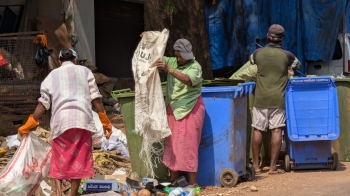
Even for those formally employed in municipal tasks, the conditions remain harsh. Mayur, a door-to-door garbage collector, paints a vivid picture of these daily struggles. Despite working exhaustive split shifts, four hours in the morning and four in the evening, the fight for basic summer provisions and safety gear continues.
Traveling from house to house on foot, many resort to just using a wrapped-up towel around their heads to protect themselves from the sweltering sun. As if the summer's heat wasn't enough, hygiene has become another massive, unresolved issue for these workers.
"We don't even have basic amenities like proper uniforms or hand gloves," Mayur explains. "They provide gloves only twice a month, but they often cut or spoil after just a few shifts." As a result, Mayur and his coworkers frequently find themselves sorting through mixed garbage with their bare hands.
The state government has recently attempted to intervene. Following a meeting chaired by the Secretary of Revenue and Labour, a mandate was issued stating that workers must not be made to work in the direct sun between 12 pm and 3 pm, and that adequate clean drinking water must be provided.
CALL FOR ACCOUNTABILITY
However, Roland Martins, Coordinator of the civic action group GOACAN, points out that the implementation is where the system fails.
"The violations could be seen at the road construction, road cleaning, and underground cable laying works where there was no visible supervision," Martins notes.
He speaks of a noticeable disparity in how workers are treated, attributing much of the exploitation to the outsourcing of government work. "In most cases, the outdoor work of Government Departments is subcontracted, which results in workers being taken on a daily wage basis, thereby there is no direct supervision," he explains.
The issue goes beyond just enforcing afternoon breaks; it requires systemic operational changes and accessible communication. Martins asserts the need for comprehensive, localized guidelines from the Inspectorate of Factories & Boilers. "Besides issuing the same in English, there is an urgent need for the same to be issued in the vernacular, and the use of social media is as important to reach the target audience," he states.
Likewise, safeguarding workers extends past their shifts and into their homes. Many of these labourers are migrants living in precarious conditions that exacerbate their health risks. "Many a time the living conditions of migrant workers and contract workers are not taken into account," Martins says, urging Village Panchayats and Municipal Councils to step up and ensure proper health and sanitation in rented accommodations.
A BETTER TOMORROW
This International Workers' Day, the narrative in Goa must shift from mere celebration to urgent, actionable empathy. From the traffic cop seeking refuge under a tree to the garbage collector sorting waste barehanded, the dignity of labour means little without the guarantee of a safe, humane working environment.
Until protective gear, strict enforcement of operational protocols, and proper infrastructure become undeniable rights rather than unfulfilled demands, May Day will remain a sobering reminder of the long road ahead for Goa's most vulnerable workforce.


