While the train of life continues on its unknown course, each individual will, at some point, reach a station where the journey concludes
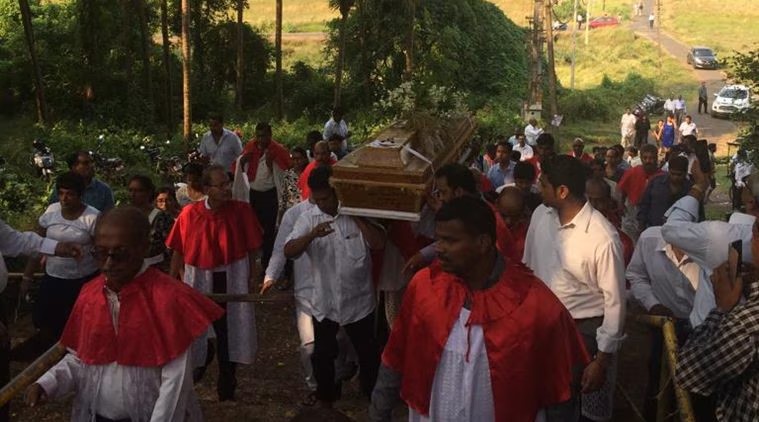
It was seen that a group of men walked in quiet formation along a familiar Goan road, carrying a wooden coffin beneath the shade of old trees. There was no haste in their movement, nor any visible disruption to the world around them. Vehicles remained parked, conversations lingered in the distance, and life, in its indifferent continuity, moved on.
Within that coffin lay a man who had been known since the year 1998—not intimately, not daily, but with a familiarity that time alone can cultivate. He was the brother-in-law of a late uncle, a figure who had occupied a place in memory rather than in routine.
As the procession advanced, it was realised that this was not merely a physical journey to a place of burial. It was the quiet conclusion of a life that had intersected, however briefly, with others who now remained behind.
The stillness inside
Inside the church, the atmosphere shifted from movement to stillness. The coffin was placed before the altar, and prayers were offered in a language that has, over generations, come to define both mourning and hope.
The priest stood before the congregation, the incense rising slowly, as though marking the passage between the temporal and the eternal. Those gathered did not speak. They did not need to.
There is a particular silence that accompanies death—not the absence of sound, but the presence of something that words cannot address. It is in that silence that the finality of departure becomes most apparent.
The face of the departed, composed and distant, no longer reflected the passage of time. It bore instead the stillness of conclusion.
Weight of helplessness
Amidst the rituals and the structured dignity of the ceremony, there arises a deeply personal sentiment—one that is rarely spoken of, yet universally experienced. It is the feeling of helplessness.
There exists, within every individual, an instinct to intervene, to preserve, to extend the presence of those known to them. When confronted with death, that instinct finds no expression. It is rendered ineffective, not by lack of will, but by the limits of human control.
It was felt that nothing more could have been done. No action, no effort, no intervention could have altered the outcome. The recognition of this limitation does not diminish the sense of loss; rather, it deepens it.
For in that moment, it is not merely the passing of another that is acknowledged, but the boundaries of one’s own capacity.
Stations of departure
Life, when observed in retrospect, resembles a shared journey. Individuals enter, accompany one another for varying durations, and then depart at points unknown to those who remain.
Some departures are anticipated, others arrive without warning. Yet, all share a common characteristic—they are final.
The image of a train leaving a station offers an apt reflection. One stands still, watching as it gathers distance, aware that no recall is possible. The tracks remain, the journey continues, but the presence within that departing carriage is no longer accessible.
In this instance, the departure was neither dramatic nor publicly pronounced. It occurred with the same quietness with which the man had existed within the broader fabric of life.
Perhaps the most difficult aspect of such moments is not the loss itself, but the continuity that follows it. The road upon which the procession passed will tomorrow carry the same traffic. The church will open its doors for another congregation. Conversations will resume, obligations will persist, and the rhythm of life will remain unchanged. Yet, something has altered.
An individual who once occupied a place, however modest, within this shared existence, is no longer present. That absence does not announce itself loudly, but it is felt in subtle and enduring ways. It is in these understated absences that the fragility of life is most clearly understood.
A quiet realisation
In the end, what remains is not resistance, nor an attempt to rationalise what cannot be altered. What remains is a quiet realisation.
That life does not always depart in ways that command attention. That not all losses are measured by proximity. That even distant connections, sustained across years, carry a significance that reveals itself only in absence.
And above all, that while the train of life continues on its unknown course, each individual will, at some point, reach a station where the journey concludes.
Until then, those who remain are left with memory, reflection, and the silent acceptance that accompanies both.
After the burial
It was observed that scarcely forty-five minutes after the burial, a shift occurred within the domestic space of the deceased. The solemnity that had accompanied the final rites appeared to give way, not to reflection, but to discord.
A paternal relative of the departed was seen asserting authority within the household, directing words of defiance towards the niece of the deceased, and extending discourtesy even towards those who had gathered in quiet support. This was despite the fact that the entire sequence of funeral arrangements had been undertaken by the relatives of the niece, with diligence and without display.
Such moments, though uncomfortable to acknowledge, are not unfamiliar within Goan family structures. The occasion of death, which ought to unify, sometimes reveals underlying divisions that had long remained unspoken. Where one section of the family embodies responsibility and selfless contribution, another may, consciously or otherwise, turn its attention to questions that lie beyond the immediate moment of loss.
It is often at the very threshold of mourning—the date upon which inheritance is understood to open—that the focus of some begins to shift from remembrance to reckoning. The transition is subtle, yet perceptible. Words change in tone, gestures acquire weight, and the atmosphere alters in ways that cannot be easily articulated.