It's pretty shocking when you see someone with a Christian-sounding Goan name lashing out at Muslims, Islams and their faith system and culture as a whole. But this does happen. You only need to track the views being expressed on WhatsApp these days, and you will run into such trends pretty soon.
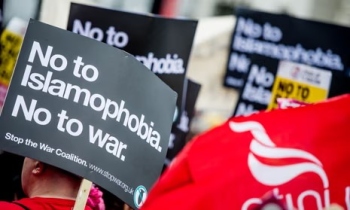
Of course, Islamophobia is a thing. Globally, it's a well crafted ideology; one which has many diverse supporters who back it for different reasons. Over the decades (if not centuries), it has built up its own tropes, stereotypes and intense biases. All ready to be cut-and-paste, and transplanted onto our own biases.
One would not expect this, given that, in an Indian context, both these are 'minority' communities, living in majoritarian times. They should have felt the pain of critiques of their respective faiths, and hence, one would have expected to empathise with each other.
But no. Islamophobia is a global trend which has been on the assent for some time now. It has even been given some political legitimacy as well. This is true in the USofA and our own part of the world, that is India. So, we are in a different situation now.
Everyone can dip into the global pool of bias against this religion, and pick out exactly what they want to build their own bigotry on.
Islam is presented as a monolithic, static and violent political ideology rather than a diverse religion. Muslim practices and religious beliefs are closely scrutinised. They are seen as the "enemy within" or "taking over Europe".
Sometimes, they get portrayed as a "Trojan horse" whose beliefs run contrary to democratic values. Jihad is interpreted as warfare, modesty in dress as a symbol of oppression, and all are suspected to be supporters of terrorism.
Followers of Islam also suffer from "othering" in media and political rhetoric. Their cultural and individual behaviours portrayed as inherently backwards or dangerous. All this can then justify structural discrimination in education, employment and public spaces.
As the world totters on the brink of World War III, and the fate of eight billion is in the hands of one man (or two), it is perhaps time to think how misunderstandings of our times (and bias) can lead to the glue holding all of us together coming unstuck.
Just a short while ago, one ran into a video highlighting the manner in which Zionism---a political ideology, not to be confused with the religion of Judaism---has long been shaping a deadly game. Professors Jeffrey Sachs and Yakov Rabkin, both of Jewish backgrounds themselves, have explained that, from its start, its "settler colonialism" approach has been immensely problematic. See https://youtu.be/evtMRyCWBo8
The world overwhelmingly had empathy for the Jews for what they underwent in 20th century Europe (and before too). Who cannot recall Hitler's attempt to eliminate their number by the millions. But even that does not entitle the Jewish State to provocatively attack and conveniently rope in the Trump-led US into a war that has caused billions in damages already, endangered the environment drastically, and made the world an unsafer place for everyone.
But that is not the whole story. Behind the Zionist Jews, there is also a segment of Christian Zionism. It undertakes a rather warped interpretations of scripture, to justify Middle Eastern wars, the unshackled belligerence of a Trump, and see prophecy coming to its fulfilment through bizarre conflict of this kind. This gets explained in online discussions.
Intolerance and bigotry has been alive and kicking as long as the human race has been around. Maybe it has only got worse now, in our 'developed' times. That reality we cannot change. However, the least we can do is to understand it, cope with it, and at the very least, not contribute to it.
South Asia has long lived with multiple faiths and beliefs staying side by side (sometimes back-to-back). People managed. In recent times, the use of religion for political purposes seriously threatens to unsettle all that past reality.
From our context, building bridges between other faiths, including Christianity and Hinduism, is the need of the hour. While the politicisation of faith is something else, actual beliefs of people run deep. Recognising this, unlike in the sixteenth century, might help take all forward.
Interestingly, many initiatives exist across South Asia for dialogue between religions. This goes beyond just sharing a common space for reciting one's own prayers, and instead attempting dialogue. Through study, shared spiritual practices, and even organisational programmes.
Institutions like the World Council of Churches (WCC), known for its liberal perspectives, have attempted moving beyond historical polarisations. ISKON, CBCI, the National Council of Churches in India (an ecumenical body including Protestants and Orthodox churches), and smaller ashrams seek to integrate Hindu and Christian traditions.
Prestigious institutions like Loyola's-Chennai, Xavier's-Kolkata and De Nobili-Pune have housed their own 'apostles of inter-religious dialogue'. Surprisingly, some of these were foreigners who made India their home, now they don't get visas to do so.
Online, there are tracks of small but impressive attempts underway too. From the United States come attempts like the group Hindus for Human Rights. It seeks to link religion with contemporary concerns, in a way that makes religion more relevant to diaspora populations in the West. Such initiatives need greater understanding and appreciation.
Wars, they say, start in the mind. A poem in Konkani (published recently in the 'Gulab' magazine) reminded us all that wars have no winners. One only hopes that history will be able to forgive us for the intense, killing and murderous bitterness which we've allowed to take over our minds.