Portuguese continues to exist in liturgical settings, in legal and archival records, in family memory, in popular music and in diasporic circuits
We've heard of the 'popular culture'; but what is 'unpopular culture'? This might sound like an academic discussion, but it's also something important to how today's Goa imagines itself.
In case you were wondering, 'popular culture' refers to culture, texts and meanings produced and consumed by large sections of society. These are often shaped by the mass media and market forces.
“Unpopular culture”, by contrast, refers to cultural forms, practices or expressions that lie outside mainstream appeal or beyond mass consumption. These get placed there because they are niche, marginal, resistant to dominant tastes or associated with less powerful social groups.
In fields like Cultural Studies (which looks how culture relates to power, identity and social structures), this category can cover underground art, minority languages, sub-cultural practices or works that deliberately reject commercial norms.
But rather than seeing these to suffer from a lack of value, the term often highlights how visibility, power and market forces shape what gets labeled as “popular”. So, the idea of "unpopular culture" draws attention to voices and traditions that remain overlooked or undervalued.
In the case of Goa, of course, all traditions, cultures, languages, dialects and scripts are equal. Yet, some are more equal than the others.
This point was driven home strongly recently, when a discussion came up over the Portuguese language in our world. This is not a topic discussed often. If discussed, it's mostly seen in negative light; the language is portrayed as one with little of a future.
More than that, it is pejoratively portrayed as a tongue that belonged to a closed, elite group.
By labelling Lusophone Goans as a closed-off elite group, we overlook quite a few complexities---historical, linguistic and emotional---that shaped the Portuguese language in Goa in recent decades.
Lusophone Goa: Tracing the Portuguese Language, a book this columnist was recently involved in publishing, focuses on such issues. It has chapters by 45 contributors, and covers a wide range of topics. Its contributors include members of the diaspora, partial speakers, non-speakers and those who connect to Portuguese through memory rather than everyday use, besides speakers of Portuguese. This gives us hint of how the language community has changed.
One way of dismissing things we don't like is to diminish its role, portray it as relevant to just a few, show it as something on its way out and dying. Or to suggest that it has little or no role to play in changing times.
Arguments used to dismiss the role of Portuguese in Goa typically stress its association with colonial rule. These viewpoints see it as a language of the old elite, a historically advantaged minority while holding it responsible for sidelining the development of Konkani and Marathi. But not English.
Critics argue that Portuguese has limited practical utility today compared to English for global mobility. Or that its institutional support (in education or culture) diverts resources from more widely used languages.
They also contend that everyday linguistic practice in Goa has shifted decisively toward Konkani (particularly in Nagari) and English. And that this makes Portuguese largely symbolic, archival or heritage-oriented rather than a living public language.
But, while doing so, we shut down some important questions. Like how language can be a resource, an aspiration, an inheritance, and also something that is fading.
Maybe it's time to recognise that Portuguese was not merely a tool of exclusion. It was also a medium through which Goans articulated their thoughts and feelings over many decades, if not centuries. (This has been documented exhaustively by Aleixo Costa, in his four volume work Literatura Goesa, which looks at Goan writing in Portuguese.)
We keep hearing the assertion that Portuguese is "fading" or "dying" in Goa. If we mention this more often, it could become a self-fulfilling simplification. But, by saying this, we justify the fate that smaller languages, scripts and dialects face in our state currently.
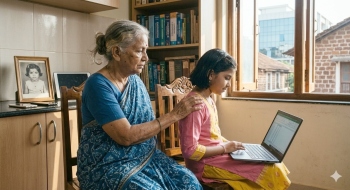
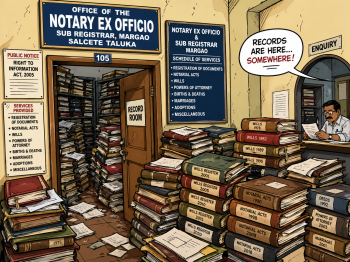
Obituaries for the Portuguese language in Goa heard so very often, since the 1970s and 1960s. Yet the language has demonstrably persisted, even if in transformed domains. It continues to exist in liturgical settings, in legal and archival records, in family memory, in popular music and in diasporic circuits.
Access to Portuguese was undoubtedly uneven. But, the pressures the language now faces in Goa cannot be explained solely through social exclusion. Structural changes have wider explanations. Like: the changing linguistic pecking-order after 1961; the rise of English in education (from the university to primary schools, despite the ham-handed Medium of Instruction imposition and the National Education Policy 2020); mobility; state policies privileging other languages; and how cultural capital got redefined.
While we dismiss the language, we try to give it a bad name. Portuguese speakers are portrayed as as uncritical subjects of Lisbon.
Yet, some of the most prominent campaigners against Portuguese rule were Portuguese speakers. Figures such as Luís de Menezes Bragança (and his daughters Berta and Beatrice), Tristão de Bragança Cunha, Telo de Mascarenhas, Julião Menezes, Laxmanrao Sardessai and Francisco Luís Gomes used Portuguese to argue for civil liberties, constitutional reform, and even the end of Portuguese rule. To conflate a Lusophone identity merely with political loyalty to the colonial state is is a convenient but lazy argument.
In fact, Goa needs to actively protect and promote its linguistic diversity—including its dialects and scripts. These are not merely tools of communication but repositories of history, identity and lived cultural memory. Let's not reject any as being too small, too remote, too closely connected to a neighbouring state or foreign country, or being a dialect or script we ourselves are not familiar with.
Reducing our plurality in favour of a single “standard” is like erasing voices and social histories. In our globalising world, smaller linguistic forms are more vulnerable. Pluralism is not a weakness; it's a resource.