What Goa’s beach carrying capacity study measured — and what it ignored. The study is not just an ecological tool, but also a sociocultural and economic one
Walk any Goan beach in October-November, and you are walking a ledger entry. The shack and temporary structure numbers, the plot boundaries, the setback distances on adjoining private lands — all of it flows from an NCSCM study in 2017, commissioned by the GCZMA on the directions of the NGT in Aleixo Arnolfo Pereira’s case. That study is the regulatory spine of Goa’s beach management. It is also the source of the problem.
The NCSCM study is not a bad document. It is a document that answers a different question from the one that Goa’s beaches are actually asking. The study calculates how many shacks and structures can be placed on private lands along a beach. It does this by measuring linear beach space and dividing it into licensable units.
The result is a number: a permissible count of temporary structures (shacks and cottages) on private land per stretch of coast. What that number does not tell you — and was never designed to tell you — is whether the beach itself can survive the activity those structures generate. Carrying capacity studies are not just an ecological tool, but also a sociocultural and economic one, as they are meant to ensure human comfort without compromising the ecological integrity of the given geographical space.
The study’s core metric is 10 sqm per visitor. That figure comes from European coastal management practice — Mediterranean beaches, peer-reviewed in temperate ecological conditions. Goa’s beaches are not Mediterranean. They are tropical.
Tropical beach ecosystems respond to visitor pressure at roughly 40 per cent greater intensity than their temperate equivalents, according to a meta-analysis of 32 global studies I completed as part of doctoral research at IIULER, Goa. The NCSCM benchmark does not account for this difference. It imports a European threshold, applies it to a tropical coastline, and calls the result a ‘carrying capacity’.
Primarily, the study measures infrastructure, not ecology. There is no baseline measurement of dune vegetation cover anywhere in the NCSCM report. Ghost crab density — one of the most reliable bio-indicators of beach health, sensitive enough to detect disturbance that visual inspection misses — is absent.
Sediment compaction rates, which determine how quickly a beach loses its structural integrity under repeated foot traffic, are not considered. The olive ridley turtle nesting beaches at Morjim/Mandrem and Agonda are designated CRZ-I precisely because their ecological thresholds are irreducible. Yet the regulatory framework that governs beach activity right up to their edges is built on a metric that has never measured an ecological threshold.
This is not an enforcement failure. Goa’s enforcement machinery is overworked. I served as an Expert Member of the GCZMA between 2019 and 2022. The complaint data we worked with tells its own story: 1,171 CRZ violations recorded in that period, roughly 60 per cent of which were concentrated in Pernem and Bardez talukas alone.
The Tourism Department’s inspections in February 2025 identified 99 violations: subletting, excess sunbeds and encroachments. Those inspections were real. But they measured commercial non-compliance, not ecological degradation. That is the difference. GCZMA watches the ledger. Nobody is watching the beach.
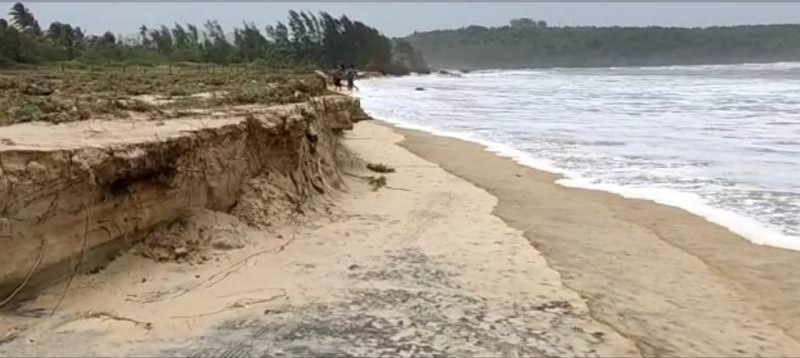
Meanwhile, the coast is telling us something. Accelerated erosion now affects between 25 and 27 per cent of Goa’s coastline. The sharpest degradation sits where tourism pressure is highest: 41 to 46 per cent of Pernem’s coast in the north, up to 38 per cent in Salcete in the south.
Mascarenhas (2000) documents widespread coastal erosion in Goa and links its spatial concentration to zones of intense tourism and shoreline modification. The mechanism is not mysterious.
Tourism-related infrastructure removes dune vegetation. Dune vegetation is what holds the sand. Remove the vegetation, and the beach’s first line of defence against wave energy and storm surge goes with it. The erosion that follows is not an accident. It is the predictable consequence of measuring the wrong things.
The NCSCM study’s methodology carried a built-in five-year review horizon. That horizon has now passed. Any reassessment of Goa’s beach carrying capacity — and there are credible indications that such a reassessment by CSIR NIO Goa is underway — faces a fork in the road. It can refine the shack and temporary structures count. Or it can ask a different question entirely: what can these beaches actually sustain? The two questions require different data, indicators, and relationships between science and policy.
Ghost crab population surveys, dune vegetation transects, tidal-state visitor counts, sediment compaction measurements at ecologically stressed sites — these are not difficult to collect. They are simply not what anyone has been asked to collect, until now.
Goa’s beach economy is real, and it matters. The 16.43 per cent contribution to GSDP, the livelihoods of fisherfolk, shack operators, and hoteliers, the seasonal employment that the coast generates — none of this is abstract. But a beach that is losing 27 per cent of its coastline to erosion is not a sustainable economic asset. It is a diminishing one.
Beaches are not simply ecological spaces. They are also social ones — places where human communities work, rest, and find meaning. Any carrying capacity framework that cannot hold both of those truths at once will keep producing the same failure.
The choice is not between tourism and ecology. It is between measuring what matters now and paying for it later when there is less coast left to measure.