Digitisation must ensure that records are not merely preserved, but are made discoverable and accessible
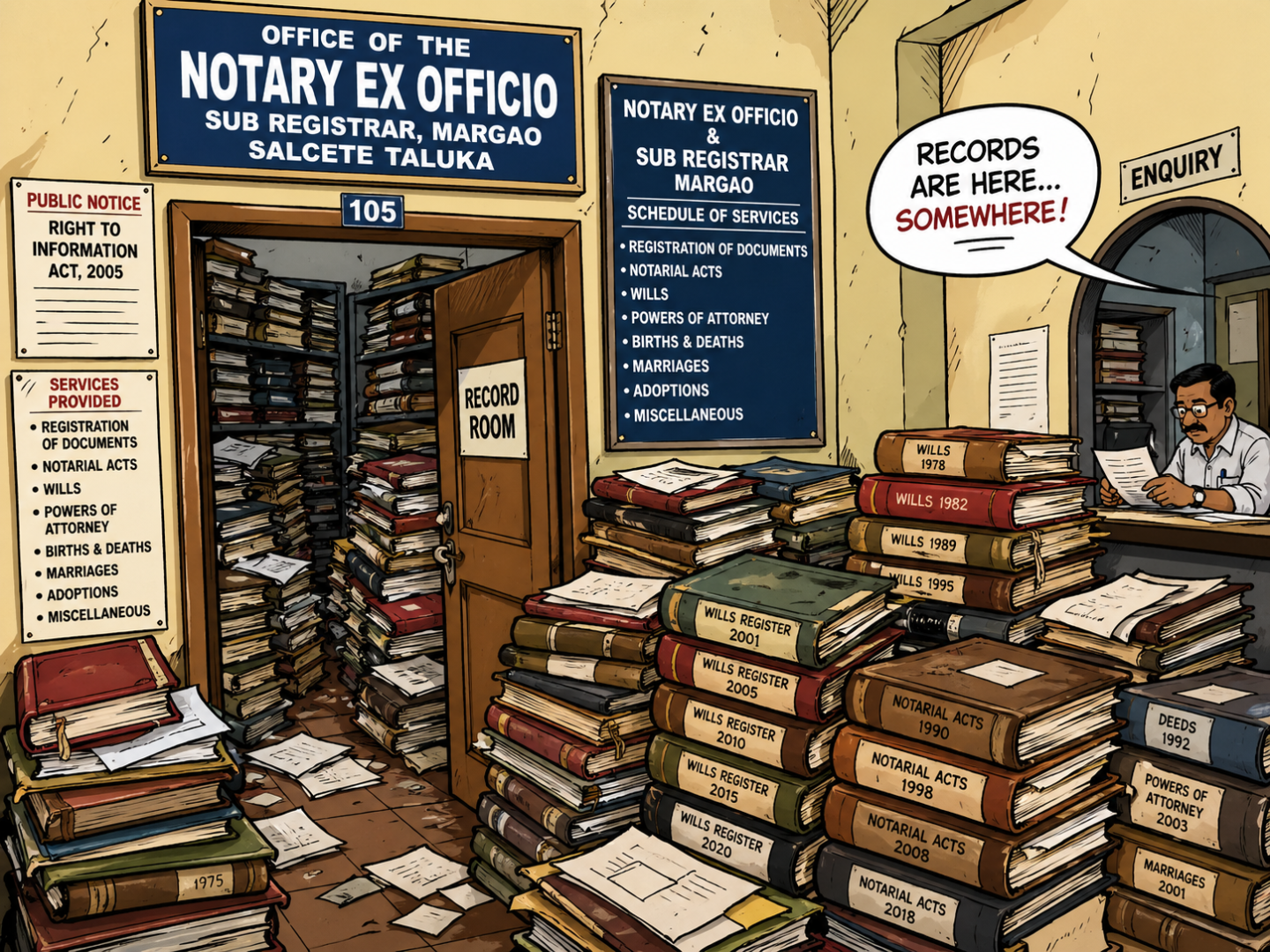
An incident at the Office of the Notary Ex Officio, Margao, located within the Matanhy Saldanha Administrative Complex, reveals the lived reality behind administrative opacity. A request had been made to trace a public will believed to have been executed by a deceased ancestor. The death certificate was produced, particulars of identity were furnished, and a bona fide inquiry was initiated.
What followed was not assistance, but institutional indifference. The inquiry was redirected to a clerk responsible for entries of wills, who declined assistance unless the exact date, book, and page number of execution were already known. When it was explained that such particulars could not possibly be known particularly where the testator had passed away without disclosure the response was startlingly dismissive. It was suggested that ignorance of such details disentitled the applicant from any benefit under the will.
The matter was escalated to the Sub-Registrar, also functioning as the Notary Ex Officio. Yet, the same position was reiterated: without precise particulars, no effort would be made to trace the record. The burden of discovery was placed entirely upon the citizen, even where the State itself remained the custodian of the record.
Secrecy of
testamentary acts
The response betrays a fundamental misunderstanding of testamentary law. A will, by its very nature, is an instrument of deferred disclosure. It is often executed in confidence and takes effect only upon the death of the testator. Beneficiaries are not always informed, nor are they expected to possess detailed knowledge of its execution.
To insist that a beneficiary must already know the date, volume, and folio of a will is to defeat the very purpose of testamentary secrecy. It converts a protective legal instrument into an inaccessible artefact.
In jurisdictions influenced by the Indo-Portuguese civil system, where public wills are formally recorded before a Notary Ex Officio, the State assumes the role of custodian not merely of documents, but of rights. That custodianship carries with it a corresponding duty to facilitate discovery, particularly upon proof of death.
The burden of
discovery
The present administrative approach effectively reverses this duty. Instead of enabling access, it imposes an unreasonable evidentiary burden upon citizens. The absurdity is evident: a record is said to exist within State archives, yet its retrieval is made contingent upon prior knowledge of its exact location within those very archives.
Such a framework renders rights illusory. It allows records to exist in theory while remaining inaccessible in practice. It also opens the door to disputes, as undiscovered wills may surface belatedly in adversarial proceedings, resulting in prolonged litigation and fractured inheritance claims.
A simple administrative mechanism verification against an indexed register upon production of a death certificate would suffice to bridge this gap. Its absence is not a matter of incapacity, but of institutional inertia.
Against this backdrop, the State’s recent directive mandating urgent updation of land records assumes a deeper significance. While aimed at preventing disputes and unauthorised transactions, the directive inadvertently exposes a structural inconsistency.
Government-owned land records are being prioritised for digitisation and correction, while civil records wills, registrations, and notarial acts remain confined to physical archives, often in disarray. In Margao, record rooms are reported to be overflowing, with registers stacked precariously and access constrained by physical limitations.
Digitisation, therefore, cannot be selectively applied. If land records merit urgent transparency, so too do records that determine succession, inheritance, and civil status.
Transparency
versus control
It is often observed that digitisation initiatives stop at internal efficiency. Records are scanned, indexed for departmental use, and stored electronically. Yet, public access remains restricted.
Such an approach preserves administrative control while withholding transparency. It creates a digital archive without creating a digital right.
True reform requires that digitised records be made searchable and accessible to the public, subject to reasonable safeguards. The success of the Goa Online platform in digitising birth and death records demonstrates the feasibility of such an approach. Records dating back decades are now retrievable through simple search parameters, enabling citizens to assert rights without procedural obstruction.
A similar model for wills and notarial records would transform the landscape of civil documentation in Goa.
Preventing institutional
arbitrary conduct
The episode narrated is not an isolated grievance; it reflects a systemic issue. When access to records depends upon the discretion of individual officials, the potential for arbitrary conduct increases. The absence of a structured, transparent system allows personal attitudes to influence public service delivery.
It is well recognised that notarial offices maintain indices of wills and registered acts. These indices serve as navigational tools within archival systems. The failure to utilise them upon reasonable request represents a breakdown of administrative responsibility.
A digitised index, searchable by name and date of death, would eliminate the present barriers. It would enable citizens to ascertain the existence of a will without breaching confidentiality or requiring exhaustive manual searches.
Conclusion
The directive to update land records must not remain an isolated reform. It must serve as a catalyst for a broader transformation of record governance in Goa.
Digitisation must be understood not as a technical upgrade, but as an instrument of justice. It must ensure that records are not merely preserved, but are made discoverable and accessible.
The Office of the Notary Ex Officio in Margao stands at the intersection of history and modernity. It houses records that define civil rights across generations. To leave such records buried in inaccessible archives is to deny citizens the very rights those records embody.
Transparency cannot be partial. It must extend to every domain where the State holds information that determines the rights of its people. Only then can digitisation fulfil its promise not as administrative convenience, but as a guarantee of justice.