Just because prejudice exists this does not invalidate Goa's long-standing culture of relative coexistence
In today's Goa, we are more concerned about conflicts about the past and fighting over our history. These matters appear more important to us than solving problems of our present and ensuring that our children have a better future.
So, history becomes the handmaiden of politics. Two trends become very clear here.
One, our past is manipulated, twisted and given a crucial spin. Propaganda takes over truth. First, a little truth is taken, that is mixed up, and myths are built over it. Real historic truths are surrounded by exaggeration, polemics and selective retellings. The end result is both lethal and provocative. It needlessly sets people on the warpath.
Secondly, those who should be knowing better (both institutions and people) are not correcting the confusion. There is no fact-checking being conducted. This could have helped to sift the truth from the propaganda. In its absence, glib campaigners get the chance to create controversy, light a fire, and then evade all action.
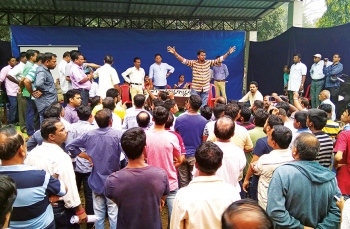
Twenty-five-year-old Gautam Khattar provocative words resulted in the generation of more YouTube sophisticated (but spin-doctored) controversies being raked up, as if to take the cue from the blunt troublemaker.
On the other hand, an Impact Evangelism channel, went about with its own "Christians Under Attack in Goa India" campaign. It is obviously based abroad. Thus we end up in a situation which could definitely not be to anyone's benefit, except those with vested interests.
Two messages
In the last week, from opposite ends of the political and religious spectrum, two messages drew my attention. Both were saying the same thing: basically, that in reality Goa doesn't live with peace and amity amongst it different sections.
That it's a myth to believe that we've had relative peace here. That Goa has never been free from communal undercurrents. Or that there is prejudice spreading quietly from our tables. Communalism begins in whispers. Likewise, it has been argued, that Goa has known bias and bigotry for long, deep into Portuguese rule.
That's an interesting point of view. Depending on our own bias (and preferences), we can see the glass in front of us as being either half empty or half full.
Yes, indeed, there is a lot of diversity (even conflicting opinions) over how we in Goa see ourselves. This has to do with so many factors. Different parts of the state have had very differing histories. Likewise, the influences of languages, scripts, cultures, migration trajectories have also been rather different, not to speak about religions and even castes.
It is easy to disagree with one another. To see the same issue in very different ways.
But, at the same time, the people of Goa can be rather interconnected too. They may have their differences, different approaches, and sometimes even dislikes; but they often live close to each other, and depend on one another.
Some communities migrate, others depend on them for business. One group depends on the other to man the offices and businesses they run. For artisan skills of varied kinds, there is a similar dependence. While politicians (and sometimes historians too) see differences, litterateurs and sociologists can recognise the overlap that happens.
Reminders
Arthur Rubinoff, the political scientist who studied Goa has commented: “As a cultural group rooted in Goan soil, and sharing the same set of traditions, all Goans [whether they be Hindus, Christians, or Muslims] recognize a common oneness that distinguishes them from others on the Indian subcontinent”.
Such reminders come from others far away too. "There is no unanimity amongst Goans as to what constitutes a “Goan” or “Goan-ness”," comments the sociologist Robert Newman. Yet, he clearly disagrees with the view promoted upto 1980 by most scholarly literature which "painted a picture of Goa as a conglomeration of separate communities".
Civil discourse is important. Especially in a sensitive and complex state like Goa. Yet, just because prejudice exists this does not invalidate Goa's long-standing culture of relative coexistence. Every society has its biases and resentments. Who is immune from stereotypes and even ideological disagreements?
For the most, such differences have not erupted into hostility or violence. Goa remains one of the more socially stable and communally peaceful regions of India, with rare exceptions apart. Shared public life between people of different faiths is not a myth. It exists. In our villages, schools, workplaces, vaddos, music events, tiatrs, feasts, temple zatras and everyday friendships.
Yet, in our social media driven world, controversial remarks rebound fast. Outrage amplifies.
Even before 1961, Goa was neither a paradise of tolerance, nor a uniformly intolerant society. It went through diverse phases. Indeed, the reality changed across centuries, regions and political circumstances.
Early Portuguese rule started with a few decades of tolerance. The initial conflict led to a slaughter of Goa's Muslim residents; often forgotten in the narration of history today.
Later, influenced by the Reformation and the like in Europe, Goa saw intolerance and coercion, which seem bizarre by today's standards. Yet, over time, Goan society evolved complex forms of accommodation. By the nineteenth and twentieth centuries, many villages had mixed populations living in relatively stable social arrangements. Konkani linked communities across religion, and economic and village life were deeply intertwined.
To continually point to bigotry of the past can easily become a justification for newer forms of bias. By the twentieth century, even before 1961, Goa had evolved into a shared Goan cultural space. Music, literature, theatre, cuisine, language and public life crossed religious boundaries to a significant extent. The question simply is: will we allow that to remain?