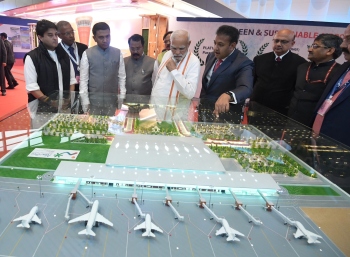
One of the major benefits of the air transport services operating in a country is the fact that it provides a vital social economic linkage.
In an attempt to establish the determinants of the passenger air traffic at the newly inaugurated Mopa Airport, the variables that affect the number of airline passengers have been extrapolated using statistical modelling.
There is the argument that a growing population has the opportunity to develop their economy than people who did not develop at all.
For instance, the economic rationale is based on determining the balance between the number of people with the natural resources available, the amount of income per capita, economic planning, the amount of labor used for the construction to be carried out and how much manpower to manage natural resources, industry, and agriculture.
Primarily, it needs to be appreciated that air transportation and the economic activity in a country are interdependent.
- Census population of Goa
- Number of passengers using domestic transit through Goan airports
- Senior citizens living in Goa
The statistical model in this analysis has been built of independent variables like Per-capita income (PCI), population (POP), with the number of passengers (PASS) as the dependent variable.
To account for regional considerations in relation to the Mopa Airport, certain binary or dichotomous variables were also added in the model.
- Number of senior citizens living in Goa who are unable to travel (SeCU);
- Preference of flying to destination versus land based modes of
transport (OthMode);
- No of passengers preferring to use Dabolim Airport (Dabolim);
- Error term (e);
- Unobservable heterogeneity (u).
- The estimated per capita income across the western state of Goa in India stood at around 4,55,000/- Indian rupees in the financial year 2021
- The Population of Goa as compared to last census 2011 was 1,458,545. A growth rate of 5.77% in the population had been estimated from year the year 2011 till 2018
- By 2005, the total passengers had increased to 987,700 (1,944 domestic plus 762 international passengers per day, year unspecified) = 7,09,560 domestic passengers per year representing a 72.8% increase of domestic air traffic passengers in 2004
- While it has been estimated that over 90,000 senior citizens are living in Goa, the proportion had increased to 10.1% in 2021.
- With the IATA full inspection still pending for Mopa Airport, hence the co-ordinates of the Airport are yet to be updated to the international navigation databases;
Now, that a model equation was designed, that could give a likely indication of the passenger traffic in consideration of the time adjusted values of the given factors and determinants.
But what would be the practical use of this equation? Could this information be used to define and execute any infrastructural development decisions? The answer to these questions would be a big resounding "Yes".
These forecasted numbers can in turn be used by the policy makers and the government administrators to plan and budget for such a rise in the inflow of the passengers at the airports and consequently take necessary actions to handle the expected growth of the population engaging in air travel.
This way governmental bodies would be able to foresee and plan ahead of time for oncoming bottlenecks.
Resultantly, the most notable inferences generated from the model include:
a) Out of the total number of passengers expected to transit through Mopa Airport, it would be highly likely that Goans would represent the smallest demographic;
b) With the enitre Goan population representing just one third of the expected passenger volume transiting through Mopa Airport, it would be more likely that the remaining two third of passengers
volume would originate from other parts of India;
c) A high per capita income of every Goan would enable more passengers to use Mopa Airport while flying to domestic destinations within India even though other modes of land transport remain available to the demographic;
d) The geographical positioning of the Mopa Airport at the extremes of the North Goa District would most likely retain the preference of South Goa residents in choosing Dabolim Airport;
e) Of the senior citizens in Goa, a demographic growing steadily at 10.1% would be less likely to use Mopa Airport due to the constraints of advancing age and excessive travel distance from certain villages and cities in South Goa.
There is the argument that a growing population has the opportunity to develop their economy than people who did not develop at all.
For instance, the economic rationale is based on determining the balance between the number of people with the natural resources available, the amount of income per capita, economic planning, the amount of labor used for the construction to be carried out and how much manpower to manage natural resources, industry, and agriculture.
Primarily, it needs to be appreciated that air transportation and the economic activity in a country are interdependent.
Some of the explanatory factors that affect the demand for air travel in Goa includes the following:
- Per-capita income in Goa (INR)- Census population of Goa
- Number of passengers using domestic transit through Goan airports
- Senior citizens living in Goa
The statistical model in this analysis has been built of independent variables like Per-capita income (PCI), population (POP), with the number of passengers (PASS) as the dependent variable.
To account for regional considerations in relation to the Mopa Airport, certain binary or dichotomous variables were also added in the model.
These include:
- Number of passengers using domestic transit through Goan airports (GoaD)- Number of senior citizens living in Goa who are unable to travel (SeCU);
- Preference of flying to destination versus land based modes of
transport (OthMode);
- No of passengers preferring to use Dabolim Airport (Dabolim);
- Error term (e);
- Unobservable heterogeneity (u).
Resultantly, the considerations taken while designing the model were:
- The airport will cater to 4.4 million passengers in the first phase and 13.1 million by the end of the fourth phase resulting in a 33.59% increase in capacity- The estimated per capita income across the western state of Goa in India stood at around 4,55,000/- Indian rupees in the financial year 2021
- The Population of Goa as compared to last census 2011 was 1,458,545. A growth rate of 5.77% in the population had been estimated from year the year 2011 till 2018
- By 2005, the total passengers had increased to 987,700 (1,944 domestic plus 762 international passengers per day, year unspecified) = 7,09,560 domestic passengers per year representing a 72.8% increase of domestic air traffic passengers in 2004
- While it has been estimated that over 90,000 senior citizens are living in Goa, the proportion had increased to 10.1% in 2021.
There were some important presumptions about the forecasting model:
- With the uncertainty of the State government in moving international operations away from Dabolim subject to approval by the DGCA, the international transit of passengers via Mopa has not been considered;- With the IATA full inspection still pending for Mopa Airport, hence the co-ordinates of the Airport are yet to be updated to the international navigation databases;
Now, that a model equation was designed, that could give a likely indication of the passenger traffic in consideration of the time adjusted values of the given factors and determinants.
But what would be the practical use of this equation? Could this information be used to define and execute any infrastructural development decisions? The answer to these questions would be a big resounding "Yes".
These forecasted numbers can in turn be used by the policy makers and the government administrators to plan and budget for such a rise in the inflow of the passengers at the airports and consequently take necessary actions to handle the expected growth of the population engaging in air travel.
This way governmental bodies would be able to foresee and plan ahead of time for oncoming bottlenecks.
Resultantly, the most notable inferences generated from the model include:
a) Out of the total number of passengers expected to transit through Mopa Airport, it would be highly likely that Goans would represent the smallest demographic;
b) With the enitre Goan population representing just one third of the expected passenger volume transiting through Mopa Airport, it would be more likely that the remaining two third of passengers
volume would originate from other parts of India;
c) A high per capita income of every Goan would enable more passengers to use Mopa Airport while flying to domestic destinations within India even though other modes of land transport remain available to the demographic;
d) The geographical positioning of the Mopa Airport at the extremes of the North Goa District would most likely retain the preference of South Goa residents in choosing Dabolim Airport;
e) Of the senior citizens in Goa, a demographic growing steadily at 10.1% would be less likely to use Mopa Airport due to the constraints of advancing age and excessive travel distance from certain villages and cities in South Goa.