Goa does not suffer from a lack of enthusiasm when it comes to addressing substance abuse. What it suffers from”year after year”is a lack of understanding. Campaigns are launched with energy and visibility. Banners appear overnight, rallies are organised, halls are filled, attendance is marked, photographs are taken, and reports are dutifully compiled. Recently, yet another 30-day anti-drug campaign unfolded across the State with great enthusiasm. What it did not unfold with was any serious reflection on how substance abuse prevention is actually supposed to work.
Prevention messaging is not neutral. Done well, it protects; done poorly, it confuses or harms. In Goa, schools often accept awareness programmes without scrutiny. Students are pulled from classrooms into sessions regardless of age or understanding. Participation becomes compulsory, consent fades, and meaningful pedagogy quietly disappears from the process.
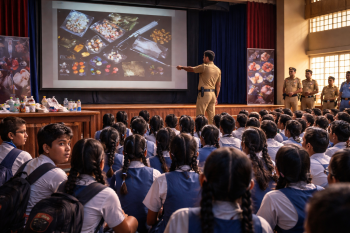
During the recent campaign, students in the 7th and 8th standards sat through long NDPS Act sessions covering offences and punishments. One wonders whether the aim was prevention or early exposure to the criminal justice system. This approach does not work. Children process risk differently at each stage of development, and what suits college students can harm schoolchildren. Yet Goa continues with a one-size-fits-all model, mistaking exposure for education and awareness for real impact.
Equally troubling is the continued reliance on fear-based messaging. Sessions conducted by enforcement agencies frequently revolve around images of drugs, lists of substances and their street names, dramatic accounts of raids, and stern warnings about punishment under the NDPS Act. The assumption seems to be that fear will deter use. Decades of prevention research tell us otherwise. Fear does not build resilience. It often builds curiosity, secrecy, and silence. In some cases, it normalises the very substances it seeks to discourage by naming, showing, and repeatedly discussing them without context.
Equally troubling is the reliance on fear-based messaging. Sessions often focus on images of drugs, street names, raids, and punishments under the NDPS Act, assuming fear will deter use. Research shows otherwise. Fear does not build resilience; it can foster curiosity, secrecy, and silence, sometimes even normalising substances by repeatedly presenting them without context.
Then there are the rallies. Students march with placards declaring “Say No to Drugs,” supervised carefully, smiling for photographs. The images are impressive. They look excellent in institutional activity reports and on social media. What they do not do is reduce substance use. Rallies do not build resilience, and slogans do not substitute for strategy. But they do create visible proof that “something was done,” which appears to have become an objective in itself.
Adding to this choreography is the annual anti-drugs marathon organised by the Anti-Narcotics Cell, now a familiar fixture in Goa’s prevention calendar. Hundreds run, banners flutter, commitment is publicly displayed, photographs are taken”and then, much like the runners at the finish line, the system seems to slow to a halt. Physical fitness is good for health, but it remains unclear how a once-a-year run translates into sustained prevention, early identification, or support for vulnerable children and adolescents. Substance abuse is not a sprint problem; it is a long-distance crisis. Treating it like an annual fitness event may look energetic, but it does little to build the endurance that real prevention requires.
More recently, creativity has entered the prevention space in the form of reel-making competitions. Creativity is welcome, but one must ask whether reels are now expected to compensate for the absence of a coherent, evidence-based prevention framework. When substance use is rising, when early initiation is a concern, and when mental health and addiction are increasingly intertwined, it is worth asking whether our response has been reduced to hashtags, edits, and applause.
Schools find themselves trapped in this confusion. Rarely are they empowered to refuse sessions that are developmentally inappropriate or poorly designed. There is little discussion on safeguarding, on triggering content, or on what happens if a child reacts emotionally during or after such sessions. Follow-up support is almost never planned. Prevention without protection becomes negligence, but it continues to be celebrated as participation.
At a systemic level, substance abuse in Goa suffers from an even deeper problem: it falls between departments. Health sees it as treatment, something to address once dependence has already developed. Police see it as crime. Education sees it as discipline. Social Welfare sees it as peripheral. The result is collective abdication. Everyone touches the issue briefly, and no one owns it fully.
This is why substance abuse remains largely absent from structured mental health planning, particularly for adolescents and young people. There is no unified prevention strategy, no age-segmented framework, and no sustained funding for interventions that are known to work. What exists instead are short campaigns, enthusiastic launches, and the quiet hope that visibility will somehow translate into impact.
Real prevention does not work this way. It is not event-based; it is system-based. It requires age-appropriate, curriculum-linked interventions that begin early and continue consistently. It requires trained facilitators, not just well-intentioned speakers. It requires integration with mental health services, clear referral pathways for at-risk children, and sustained engagement with parents, teachers, and communities. Most importantly, it requires students to be active participants, not passive audiences enduring lectures that neither speak their language nor reflect their realities.
Goa does not need more enthusiasm. It needs coherence. Substance abuse is not a seasonal issue that can be addressed in 30 days. It is a long-term public health challenge that demands strategy, funding, coordination, and humility. Until Goa develops a clear, age-appropriate, evidence-informed prevention plan”until departments stop passing responsibility like a baton, and until schools are protected from inappropriate messaging in the name of awareness”we will continue to confuse activity with effectiveness.