St Bartholomew, one of the Twelve Apostles, was a close friend of Christ who let himself be transformed by His love. Faithful to Jesus, he spread the Gospel with zeal and gave his life as a witness. The Catholic Church honours his feast on August 24, celebrating his discipleship and martyrdom.
A Jewish man from Cana in Galilee, he was chosen by Jesus as one of the Twelve. His name appears sixth in Matthew (10:3), Mark (3:18), Luke (6:14), and seventh in Acts (1:13). Bartholomew is a patronymic, “son of Tolmai,” from the Hebrew Bartholomaios, linked to a ploughman. In St John’s Gospel, he is Nathaniel. Beyond the apostolic lists, Scripture says little.
Apocryphal Gospels recount that as a child he fell gravely ill but was healed through the Virgin Mary, who placed him beside the infant Jesus. Writers and Catholic tradition long identified him with Nathanael (“God has given”) in John (1:45–51; 21:2).
In Gospel lists, he is linked with St Philip. By the 9th century, tradition firmly associated him with Nathanael. According to John (1:43–51), Philip brought Nathanael to Jesus. Seeing him, Jesus said: Here is a true Israelite; no duplicity in him. Nathanael, amazed, asked how Jesus knew him. The Lord replied: Before Philip called you, I saw you under the fig tree. Scripture does not reveal what happened there, but this encounter led Nathanael to proclaim Jesus Son of God and King of Israel. Soon after, he was at the Cana wedding feast, witnessing Christ’s first miracle.
As a native of Cana (cf. John 21:2), he saw the great sign Jesus performed (cf. John 2:1–11). He was also among those to whom the Risen Lord appeared by the Sea of Tiberias (John 21:1–14). After a night of failed fishing, the disciples saw Jesus on the shore but did not recognise Him. At His command, they cast the net again and caught so many fish they could not haul it. John then exclaimed to Peter, He is the Lord!
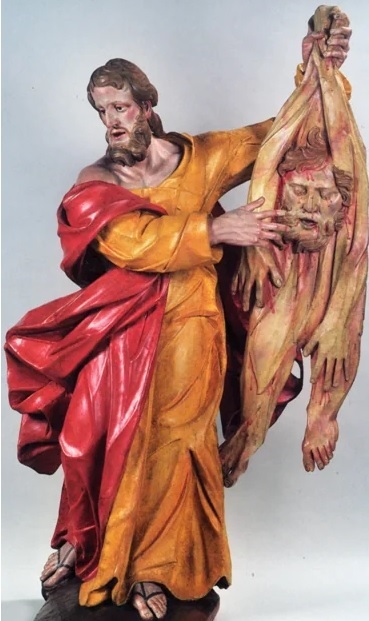
Tradition holds that after the Ascension, St Bartholomew went to India as a missionary, landing at Kallianpur, an old coastal port in Karnataka with a Jewish settlement. For nearly seven years, he travelled the Konkan, preaching and founding communities across Karnataka, Goa, and Maharashtra—including Sindhudurg, Ratnagiri, Raigad, Mumbai, Kalyan, and Thane—where Jewish colonies existed. Before leaving, he gave St Matthew’s Gospel to the Christians in India and continued to Armenia.Eusebius and St Jerome record that Bartholomew preached in India along the Konkan. With St Jude Thaddeus, he evangelised in Ethiopia, Mesopotamia (Iraq), Parthia (Iran), Lycaonia (Turkey), and Armenia. He cast out demons, healed the sick, restored sight, and urged conversion to Christ. He converted King Polymius and his queen, angering the king’s brother Astyages. In fury, Bartholomew was flayed alive. Art often shows him flayed, holding his skin. Tradition says only his eyes and tongue were spared, and with them he proclaimed Christ until Astyages had him beheaded.
Missionary work
Some traditions hold his relics are in the Church of St Bartholomew in Rome. Remembered for miracles—especially extraordinary weight of objects—he is venerated as patron of cobblers, tanners, leather workers, plasterers, trappers, cheese and salt merchants, butchers, bookbinders, and protector against twitching and neurological disorders.
Historians suggest some Indian place names trace to him. Bar (son), Tolmai, and Ooru (village) inspired Barthuru, later Barkuru, Udupi, Karnataka. His legacy is also in Goa, with two churches: Chorão’s Igreja de São Bartolomeu (1569) and a Jesuit-built one in Chicalim (1625, restored 1747). Though first dedicated to St Bartholomew, it was later rededicated to St Francis Xavier.
Harvesting rice sheaves in Tiswadi
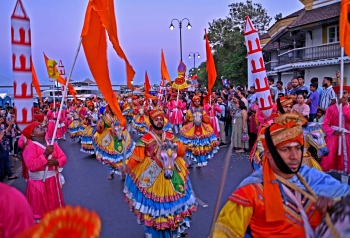
In Goa’s tradition, the first sheaves are ceremonially blessed and harvested on August 24 in Tiswadi- the feast of St. Bartholomew. The Apostle’s very name carries agricultural symbolism, which may explain the association of his feast with the blessing of new rice. Furthermore, historians such as Heras, Mascarenhas, Perumalil, Philip, and Costa highlight St. Bartholomew’s missionary work along the Konkan coast, strengthening his cultural and spiritual link as patron of the harvest festival.
In Betalbatim, the saint is locally known as Bethal or Bhethal, and his feast continues to be celebrated there and in Carmona. Historians suggest that Betalbatim may derive its name from biblical origins, linking it to Bethphage in ancient Israel, reflecting broader traditions of apostolic Christianity in the Konkan region.