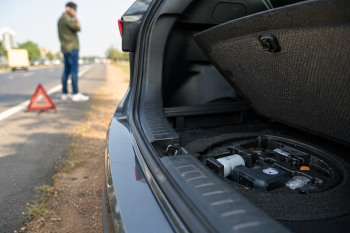
For decades, the “stepney” was a non-negotiable part of every car in India. It sat quietly in the boot, rarely used but always reassuring. Today, that familiarity is fading. A growing number of new cars”across hatchbacks, sedans and even SUVs”are being sold without a spare wheel, replaced instead by puncture repair kits or tyre inflators.
Why carmakers are dropping the spare
One major reason is a change in rules. In 2020, the government allowed passenger vehicles to be sold without a spare wheel if they have tubeless tyres, a tyre pressure monitoring system (TPMS) and a repair kit. This gave manufacturers the freedom to rethink how they package cars.
Weight reduction is another key factor. A spare wheel, along with tools, can add up to 10“18 kg. Removing it helps improve fuel efficiency. In electric vehicles, this also helps increase driving range. As emission norms become stricter, even small weight savings matter.
There is also a cost angle. A spare wheel, especially a full-size one, is not cheap. By replacing it with a repair kit, manufacturers reduce costs. While the saving per car may look small, it adds up when produced in large numbers.
Space and modern design needs
Modern cars are more complex than before. Hybrid and electric vehicles, in particular, need space for battery packs and electronics. In many cases, this space comes at the cost of the spare wheel compartment.
Even in regular petrol and diesel cars, removing the spare can free up boot space. This allows manufacturers to improve practicality or fit other components more efficiently.
Technology is changing the approach
Advances in tyre technology have also made this shift easier. Tubeless tyres are less likely to fail suddenly. TPMS alerts drivers early if there is a loss of air pressure, giving them time to act.
Repair kits and portable inflators can handle minor punctures quickly. In cities, easy access to roadside assistance and tyre repair shops further reduces the need for a spare wheel.
Concerns for Indian conditions
Despite these changes, the move is not without problems. Repair kits are limited in what they can fix. They usually work only for small punctures in the tread. If there is sidewall damage or a major tyre burst, they are of little use.
For drivers who travel long distances or drive on poor roads, the absence of a spare wheel can be risky. In many parts of India, tyre repair shops may not be easily available, especially at night or on highways.
This is why some manufacturers still offer a spare wheel in higher variants or as an option. Vehicles designed for rough use, such as larger SUVs, are also more likely to retain a spare.
A gradual shift, not a complete exit
The disappearance of spare wheels is not uniform. Some entry-level and city-focused cars are more likely to skip them, while others continue to offer them. In some models, lower variants miss out while higher trims include a spare.
Overall, the change reflects a shift in priorities. Car design today focuses more on efficiency, cost and technology. Traditional features like the stepney are no longer guaranteed.
For buyers, this means checking specifications more carefully before purchase. The spare wheel may still exist, but it is no longer something you can take for granted.