PANAJI
Last Sunday in Vasco, Gautam Khattar, a self-styled right-wing social media influencer, stood before a gathering and launched into a tirade against St Francis Xavier, the sixteenth-century Catholic missionary revered in Goa as Goencho Saib.
His remarks branded St Xavier a “terrorist” and ridiculed the veneration of his relics. It met with immediate outrage, and within hours, videos of the speech circulated online, sparking protests, candlelight marches, and demands for Khattar’s arrest.
For many Goans, the episode felt like déjà vu. Just two years ago, in 2024, Subhash Velingkar, a former RSS leader, made similar derogatory comments about St Xavier, triggering a storm of condemnation.
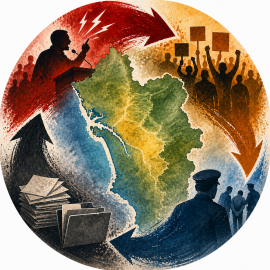
In both cases, the pattern was strikingly similar: provocation, public anger, police action or inadequate action, and political distancing. Yet, as history shows, the cycle rarely ends with meaningful prosecution.
Why do such incidents keep occurring? One obvious reason is the political capital that is there to be gained through polarisation.
Goa’s unique cultural fabric, where Catholic, Hindu, and Muslim traditions coexisted, has long been a point of pride. But it also makes the State a fertile ground for provocateurs who seek to fracture this harmony.
Targeting St Xavier, whose annual feast draws thousands across faiths, and the decennial 'Exposition' of his relics several millions is a calculated move. By attacking a figure central to Goa’s identity, speakers like Khattar and Velingkar aim to mobilize ideological bases and provoke reactions that amplify their visibility.
Social media megaphone
Unlike earlier decades when such speeches remained confined to local audiences, today’s provocations are designed for virality. Khattar’s brother, Madhav, according to the Vasco police, played a key role in scripting and disseminating the Vasco speech online. And so, he was arrested and brought to Goa from their Dehradun home.
The outrage it generated was hardly accidental and visibly engineered. In the age of algorithm-driven platforms, controversy equals reach, and reach equals influence.
But the most critical factor is the absence of any consequences for anyone.
Velingkar’s 2024 case never reached trial. FIRs were filed, statements recorded, but the matter quietly faded.
This lack of closure emboldens the offenders who repeat the offences. For them, the risk is minimal compared to the political mileage gained.
As one protester at the Margao candlelight march put it: “They know nothing will happen. That’s why they keep doing it.”
Lack of legal follow-through
The real test lies in whether cases are prosecuted, eventually leading to closure. Without prosecution and judicial closure, arrests remain symbolic gestures, says noted lawyer, Ryan Menezes, trapping Goa in a predictable cycle whenever such incidents occur.
"The pattern is painfully familiar: immediate outrage, multiple complaints, loud demands for arrest, and a flood of social media posts. Anticipatory bail applications follow, protests lose steam, and public attention shifts. The case itself rarely reaches its logical conclusion," he said.
Menezes, who often appears in criminal matters on the defence side before the Bombay High Court as well as lower courts, also notes that these cases of public statements derogatory of a revered saint are not complex investigations requiring forensic breakthroughs.
"The offender is known, evidence lies in eyewitness accounts and video recordings, and witnesses can be identified easily. A chargesheet could be prepared within a week and trials could begin promptly. Instead, prolonged 'investigations' drag on for months, only to end in closure reports years later when interest has faded," he said.
Unless citizens demand accountability beyond the initial outrage, Menezes warns, such episodes will continue to generate heat but no light.
This is where Goa’s copybook cycle falters. Despite arrests and FIRs, cases rarely reach their logical end.
In 2024, Subhash Velingkar’s remarks against St Xavier sparked outrage. FIRs were filed, protests held, and political leaders condemned the speech. Yet, two years later, the case has all but disappeared from public discourse. No trial, no conviction, no deterrence.
Police response: Options and limitations
Goa Police moved seemingly quickly against Khattar. An FIR was registered under sections of the Bharatiya Nyaya Sanhita for promoting enmity and outraging religious feelings. A lookout circular was issued, and now Khattar has been taken into custody by a Crime Branch team from Kullu district of Himachal Pradesh.
A couple of days earlier, his brother Madhav was arrested as a co-accused, with police alleging that he played a crucial role in scripting the speech and then amplifying it through social media platforms. However, the arrest led many to slam the police and claim it was only a spectacle to hide the embarrassment of failing to net Gautam.
But beyond arrests, what options do law enforcement really have?
A senior police official connected with the probe said, one option was to target the 'networks' rather than just the individuals. "Left to us policemen, this is not impossible. But the political executive must provide the backing, which often falls short," the officer said.
In this particular case, by arresting Madhav, police signaled recognition that hate speech is often a coordinated act. This has opened the door to treating such incidents as 'conspiracies' rather than isolated, impromptu outbursts.
"Investigating the funding, logistics, and organisational support and then prosecuting the link-men as well, can deter future events," the officer said.
Accountability of organisers
The Vasco event was hosted by the Sanatan Dharm Raksha Samiti. While organizers distanced themselves after the controversy, police questioning revealed financial arrangements and logistical backing.
Holding event organizers accountable through criminal liability could prevent such platforms from being misused.
Also, adopting stricter vetting of speakers at public gatherings, especially those with prior records of communal provocation, is another aspect often ignored by the police and the administration.
This (preventive policing) signals the seriousness of the government and administration about maintaining harmony.
Political calculations
A major part of the problem lies in political patronage. Transport Minister Mauvin Godinho and Vasco MLA, Krishna (Daji) Salkar, were present and seated on the dais at the Vasco event where Khattar made the obnoxious remarks. Both faced flak for being mute spectators and not objecting to the controversial remarks of Khattar.
Although Godinho and Salkar later denounced Khattar and his remarks, critics are not buying it, arguing that offenders are shielded by such political connections, making prosecution inconvenient. For the ruling Bharatiya Janata Party (BJP), pursuing such cases risks alienating segments of its core support base. Which is why, citizens in general are by and large sceptical, evident from the candlelight march in Margao, where the government was served a 24-hour deadline to arrest Khattar.
“We’ve seen this before,” said one marcher. “They arrest, they release, and then nothing else happens.”
Larger implications
Such communal flare-ups are not just about one episode, but reflect a deeper malaise in Goa’s governance and justice system.
When offenders face no real consequences, hate speech becomes somewhat normalised, and each incident pushes the boundaries further, eroding communal harmony.
Also, the public's trust and faith in the police and other institutions, including the judiciary, suffers when cases are abandoned midway, further weakening the 'State'.
Risk to Goa’s identity
St Xavier is not just a Catholic saint but a symbol of Goa’s pluralism. Attacks on him are also seen as attacks on the State’s cultural ethos. Failure to protect that ethos risks redefining Goa’s identity in divisive terms.
The Vasco controversy has again exposed Goa’s vulnerability to orchestrated provocations and while the arrests and FIRs are necessary, they alone are insufficient.
Unless law enforcement and judiciary ensure that cases are prosecuted to a logical end: either conviction or acquittal, it is more likely than not that Goa will continue to witness this cycle of outrage and inertia.
The challenge is not merely to arrest offenders but for the 'State' to demonstrate that communal harmony is protected by the law, not merely by public protest.
As long as prosecutions remain incomplete, provocateurs will keep returning to the stage, confident that outrage is fleeting and consequences are negligible.
In Goa, the choice must be made: either break the cycle or risk becoming a State where hate speech is not an aberration but a routine spectacle, especially in a year where the State is due for a general election.