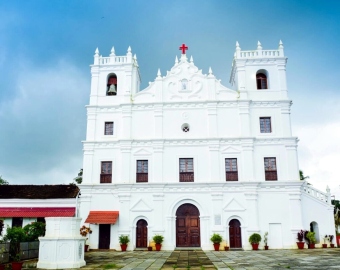
The Church at Aldona is dedicated to St Thomas the Apostle, and the parish celebrates the feast on the third Saturday after Easter, which this year falls on April 25.
THE ORIGIN
The Christian faith was introduced to the village by the Franciscan missionaries. The first church, built in 1569 at Coimavaddo, was a modest structure of mud walls and a thatched roof. According to Mons. F. X. Gomes, this foundation took place during the tenure of Fernando da Paz, while Dom Jorge Temudo served as Archbishop (1568“1571).
By 1596, the growing Christian population made the original church inadequate. The villagers decided to construct a larger church at a new site, each contributing 12 xerafins. This initiative took place during the episcopacy of Dom Aleixo Menezes.
On March 13, 1603, the Rector, Frei Rodrigo do Espirito Santo, urged the community to replace the old mud structure with a stone church. The people generously provided land and funds, and the new church was completed in 1610.
The Franciscans continued to serve the parish until their expulsion from Goa by the Portuguese government. Administration was then transferred to diocesan clergy, with Fr Agostinho Correia as the first diocesan parish priest.
THE DEVELOPMENTS
Over time, the church underwent several additions and renovations. The staircase and courtyard were built by Fr João Francisco Lobo, and the cemetery dates back to 1783. In 1897“1898, the parochial house and sacristy were reconstructed.
During this period, Mass was celebrated at the chapel in Cottarbhat, and the parish priest resided in Carona.
Further improvements included the re-tiling of the roof in 1922, the addition of a left-side tower in 1927, and repainting of the church in 1991. In 1988, Fr Jose Dias organised a small museum in the church corridors, displaying statues and paintings, including works from the time of Fr Jose Barretto. The parish marked 425 years of its existence in 2021.
THE ARCHITECTURE
The church is built in the Mannerist Neo-Roman style. It is a large structure with five bays and a simple nave without side galleries. The central bay follows a vertical sequence of arch, rectangle, oculus, and niche, creating balance and rhythm.
The façade is divided into three storeys by broad friezes and rises symmetrically, with the central portion higher than the sides. Twin towers flank the structure, the left housing the bell. Balustrades, murals, and statues enhance its beauty.
At ground level, five doors open into the nave, while the second tier has five windows. At the top stands a cross above a niche containing the statue of St Thomas. The sacristy houses an altar depicting St Thomas with the Risen Christ, and above it an image of Our Lady surrounded by saints.
Within the compound are a large cross on a pedestal, a pulpit, a statue of Christ the King and a grotto of Our Lady of Fatima. The cemetery lies opposite the church.
THE ALTARS
The main altar is dedicated to St Thomas, with his image in the central niche, flanked by St Peter and St Paul. Beneath it is a wooden painting of the Last Supper.
Two side altars add to the devotional richness: the right altar features the Immaculate Conception with St Joseph and St Sebastian, while the left is dedicated to Our Lady of Piety with St Anne and St Francis Xavier. Additional smaller altars honour the Sacred Heart of Jesus and the Sacred Heart of Mary, along with a grotto of Our Lady of Lourdes.
THE CHAPELS
The chapels which fall under the jurisdiction of the Parish are the Chapel of Pietà (Quitula), Chapel of Mãe de Deus (Corjuem), chapel of St Rita of Cassia (Carona), Chapel of Holy Cross (Panarim) and Chapel of Mother of God (Ranoi).
‘CHORANCHEM FEST’ (THIEVES’ FESTIVAL)
One of the most dramatic and faith-filled episodes in Aldona’s history occurred on the night of October 29, 1895.
That night, the peaceful village was shaken when a band of robbers crossed the Corjuem ferry to loot the church. They broke down the main door and entered the sacred precincts, attempting unsuccessfully to force open the iron safe. As they tried to approach the sanctuary, eyewitnesses reported a miraculous apparition”an angelic figure with a drawn sword blocking their path and declaring in Konkani: “Fuddem vocho nakat, borem zaunchem na.” (Go no further, nothing good will come of this). Terrified, the robbers replied, “Ho re khoincho por, amkam sangunk ieila.” (We do not know who this man is, but he has come to warn us).
Hearing the church bells and commotion, the villagers rushed to the scene, armed with spades, bamboos, and sticks. The robbers tried to flee in canoes, but the villagers pelted them with stones and bullets. In the ensuing skirmish, sixteen robbers were killed, four were captured, and several others drowned while attempting to escape.
In gratitude for this miraculous deliverance, the people of Aldona began to celebrate the event each year as the “Choranchem Fest” or “Thieves Festival”, held on 29 October with a solemn Eucharistic celebration. This has been discontinued now.