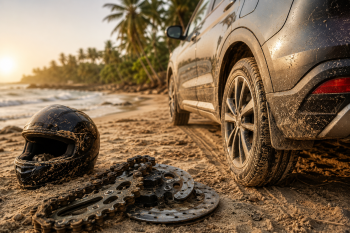
For many people in Goa, a vehicle and the beach often go together. Tourists park scooters near the shoreline, SUV owners drive onto sandy stretches for photographs, and many locals regularly travel through coastal roads lined with sea breeze and loose sand. While the beach may feel relaxing for people, it is often far less friendly for vehicles.
Most owners worry about potholes, fuel prices or servicing costs, but beach sand is one of the most ignored causes of long-term vehicle damage. The problem is not just the sand itself. In coastal regions, sand works together with moisture, humidity and salty sea air, creating conditions that can quietly shorten the life of many vehicle components.
Sand enters more places than people realise
One of the biggest problems with beach sand is how easily it spreads. Fine sand particles can travel into small gaps and moving parts without owners noticing immediately. Unlike mud or visible dirt, sand often stays hidden while slowly causing wear.
Two-wheelers are especially vulnerable. Sand can enter chains, sprockets, brake components and wheel bearings. Over time, this creates friction that speeds up wear and reduces smooth movement. Riders who frequently park close to beaches may notice chains becoming noisy or rough much earlier than expected.
Cars face similar issues. Sand can collect around brake discs, suspension joints and underbody sections. Once trapped, it acts almost like sandpaper, gradually wearing surfaces during daily driving. Drivers may eventually hear unusual noises from brakes or suspension without immediately connecting the issue to beach exposure.
Even vehicle interiors are not fully safe. Sand carried inside footwear can settle into seat rails, carpets and air-conditioning vents. Anyone who has rented a beachside scooter or car in Goa would know how difficult it is to completely remove fine sand from a vehicle’s cabin.
Bigger danger is salt
While sand alone can create problems, the real threat comes from salt present in coastal air and water. Salt accelerates corrosion, especially when it mixes with moisture during monsoon months.
This is why vehicles used regularly near beaches often show rust earlier than vehicles used inland. The underbody is particularly exposed because salty moisture settles underneath and is not cleaned properly during normal washing.
Many owners focus only on visible paint damage, but corrosion usually begins in hidden areas first. Exhaust systems, bolts, brake lines, suspension mounts and metal joints can slowly weaken over time. By the time rust becomes visible, damage may already be extensive.
In Goa and other coastal regions, mechanics often see vehicles with rust-related problems despite being relatively new. Owners are sometimes surprised because the vehicle’s exterior still appears clean and polished.
SUVs are not invincible
Social media has made beach driving look glamorous. Videos of SUVs driving on sand or parked beside waves are now common. However, many people underestimate how harmful sand can be even for larger vehicles.
Driving directly on soft sand increases stress on tyres and drivetrains. Wheels can spin excessively while trying to gain grip, which puts extra load on mechanical parts. Vehicles can also get stuck more easily than drivers expect.
Sand entering brakes or underbody components after beach driving can later create long-term issues if not cleaned properly. In some cases, sand mixed with moisture hardens around components, making cleaning more difficult later.
There is also the risk of saltwater exposure. Even small amounts of seawater splashing underneath a vehicle can accelerate corrosion if not washed off quickly.
Two-wheelers suffer quietly
Scooters and motorcycles are extremely common in Goa, especially around tourist areas. They are also more exposed to coastal conditions than cars.
Unlike cars, many two-wheelers remain parked in open areas near beaches for long periods. Constant exposure to salty air affects chrome parts, exhausts, fasteners and electrical connections. Owners may notice rust spots, fading paint or electrical issues earlier than expected.
Beachside parking also exposes rubber parts to heat and salt-heavy moisture. Over time, this can affect seals, hoses and even tyres.
Rental scooters often show these signs fastest because they experience heavy use while spending most of their time near beaches.
Cleaning matters more in coastal areas
Vehicle maintenance habits that work in inland cities may not be enough for coastal regions. In places like Goa, regular cleaning becomes far more important.
Experts usually recommend washing the underbody frequently, especially after beach exposure or monsoon driving. Unfortunately, many owners only clean visible exterior surfaces while ignoring the underside where most corrosion begins.
Applying anti-rust coatings can help, although these are not permanent solutions. Parking in covered areas and avoiding direct beach driving whenever possible also reduces long-term damage.
For two-wheelers, regular chain cleaning and lubrication become especially important in coastal conditions.
Modern vehicles bring new concerns
Today’s vehicles contain more sensors, cameras and electronics than before. This creates fresh worries in sandy and humid conditions.
Sand and moisture affecting sensors or electrical connectors can lead to unexpected warning lights or system failures. Repairs for such components are often expensive compared to older mechanical systems.
LED lighting units, parking sensors and advanced driver assistance systems may also be vulnerable if exposed repeatedly to harsh coastal conditions.
This means coastal vehicle ownership is becoming more expensive in subtle ways, even if buyers do not realise it immediately.
A hidden cost of coastal living
For many people, beachside driving is part of the charm of living in or visiting Goa. But vehicles pay a price for that environment. The damage usually happens slowly, making it easy to ignore until repair bills start increasing.
Beach sand may appear harmless compared to rough roads or accidents, yet its effects can quietly build over months and years. Combined with salty air and humidity, it becomes one of the hidden challenges of owning a vehicle in coastal India.
For vehicle owners, the lesson is simple: beaches may be good for weekends, but they are rarely good for machines.