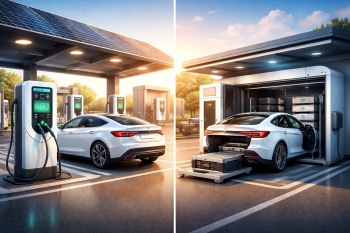
The biggest challenge for electric vehicle (EV) adoption is not how far a vehicle can go, but how easy and fast it is to recharge. Faster charging, longer battery life and a strong charging network help reduce this worry.
Another idea often discussed is battery swapping. Instead of waiting to charge, drivers replace a drained battery with a fully charged one at a station. This concept has been around for years and is seen as an alternative to fast charging.
Why fast charging is preferred
Many people ask why companies don’t focus more on battery swapping. The short answer is that improving charging technology offers better long-term benefits.
Battery swapping works well in some areas, especially small commercial vehicles or shared mobility services. But for most personal and commercial EVs, it creates several practical problems.
Quick swaps, slow recovery
At a swap station, changing a battery can take only a few minutes. However, the removed batteries still need hours to recharge before they can be reused.
This means the system works smoothly only when there are enough spare batteries available. Once the extra batteries run out, waiting times increase and the advantage of quick swapping disappears.
Cost of extra batteries
In a swapping system, the network operator owns the batteries instead of the vehicle owner. To keep operations running, the operator must maintain more batteries than the number of vehicles on the road.
This extra inventory, called “float”, increases costs. If there are too few spare batteries, drivers face delays. If there are too many, the company has to invest large amounts of money in batteries that sit unused.
As a result, swapping usually ends up costing more per unit of energy than regular charging, even if the vehicle itself becomes cheaper.
Design and space problems
Removable batteries must be smaller and easier to handle. This often means splitting the battery into multiple packs.
Each pack needs its own casing, cooling system, connectors and management electronics. Vehicles also need systems to balance power across different packs. All this adds weight, complexity and cost.
Because of these design limits, swap-ready vehicles often carry less energy than fixed-battery vehicles, which reduces driving range and increases the number of station visits.
Difficult to expand to bigger vehicles
Battery swapping becomes harder as vehicles get larger. Heavy vehicles like buses and trucks require very large battery packs that cannot be handled manually.
Automated systems are needed to remove and install these batteries, which raises infrastructure costs even more. In comparison, fast charging only requires a connector, making it simpler to scale.
Limited compatibility for drivers
Another challenge is lack of compatibility between companies. Batteries from one swapping network usually cannot be used in another.
This locks drivers into a single provider. In many cases, these vehicles also cannot use normal charging points or home charging, reducing flexibility.
Fast-charging vehicles, on the other hand, can use standard charging ports and multiple charging networks.
Less freedom for vehicle makers
Vehicle manufacturers prefer flexibility in design. Standardising batteries for swapping limits how they can build their vehicles.
Battery size, layout and structure all become restricted. Fixed batteries allow engineers to optimise space, performance and safety, and even integrate the battery into the vehicle structure.
Because of this, many manufacturers avoid battery swapping systems.
Hard to keep up with new tech
Battery technology changes quickly. When new battery designs appear, older swap stations and battery packs may become outdated.
Upgrading a swapping network becomes expensive and complicated. New vehicles may not work with older stations, creating long-term operational problems.
With fixed batteries and standard charging, newer technologies can be adopted more easily without replacing entire networks.
Tech improvement is real solution
One way to improve swapping would be to recharge removed batteries extremely fast. But if charging becomes that quick, building fast-charging stations makes more sense than maintaining a swapping system.
In the end, battery swapping can still work for specific niches. However, for most EV users, faster charging technology and better charging infrastructure appear to be the more practical path forward.