PANAJI
The State administration has moved to radically recast the Shree Lairai Devi Zatra’s crowd management architecture, ordering one-way pilgrim movement, staggered entry slots, drone surveillance and the closure of stalls and liquor outlets along the festival route in an aggressive bid to ensure that tragedy does not revisit Shirgao.
Official sources told The Goan that the district administration identified slope congestion, weak movement regulation, encroachments and inadequate monitoring as the key risk factors that had historically heightened the possibility of a crowd disaster.
One-way movement
The strongest intervention, officials said, is the decision to enforce a comprehensive crowd management framework to eliminate overcrowding on the sloped approach to the temple and the Dhondachi Tali route, areas seen as the most vulnerable during the annual influx of thousands of devotees.
Under the new plan, which was discussed at their series of meetings and a report submitted to the High Court of Bombay at Goa, the devotees will be moved through a strict one-way system with separate entry and exit routes, designated holding areas and staggered time slots to regulate crowd density. A senior official present at the meeting said the arrangements were being designed with risk mitigation as the primary objective.
The government officials, including stakeholders from the district disaster management authority, stated that they have also decided to separate Dhonds and general devotees in holding zones, to reduce sudden surges and prevent dangerous bottlenecks during the ritual movement towards the Tali.
The Deputy Collector of Bicholim has been tasked with coordinating all departments and stakeholders, including the temple committee, police, fire services, PWD, electricity department and local panchayats, for the final crowd management blueprint.
Real-time monitoring
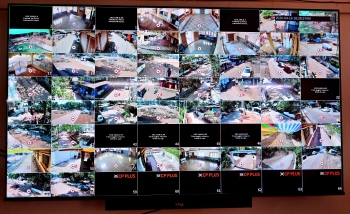
To strengthen real-time monitoring, CCTV cameras have been installed at holding areas, slope checkpoints, corridors and the Homkhand area, while drone feeds and wireless communication systems will be integrated into a Joint Command and Control Room.
Temple authorities informed the administration that CCTV cameras had already been installed at the temple premises and other prominent points.
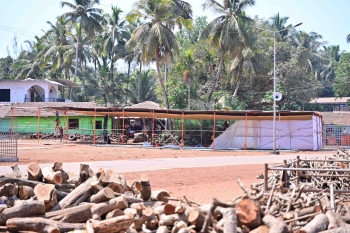
In another significant step, this time, no stalls are permitted on the route from the temple to the Tali, while residents have been requested not to set up temporary shops even on adjoining private properties. The DDMA has divided the stall permissions to manage the heavy footfall expected during the zatra. In the first phase, it has cleared stalls from April 21, covering A1 to A10 and B1 to B16 in Zone I, and D1 to D9 in Zone III. The approval is subject to specific conditions, including a reduction in the width of stalls opposite the Homkhand area from 6 metres to 5 metres. Moreover, 15 stalls proposed along the approach road to the parking area will be shifted 1.5 metres away from the roadway to maintain adequate access and exit routes for emergency vehicles.
The second phase of stall erection, approved for April 22, includes C1 to C9 in Zone I and E1 to E8 and F1 to F8 in Zone III. The Authority has directed that these stalls be set up only after 10 am on April 22, citing the large congregation for the Homkhand ritual, which concludes in the early hours of the morning.
Officials said the decision was taken to maximise corridor width and ensure free movement during peak hours. “This is crucial to ensure that emergency evacuation routes remain unobstructed at all times,” an official involved in the planning process said.
The government has also directed the closure of bars and liquor outlets in Shirgao and surrounding villages during the festival period. Infrastructure works have been placed on an accelerated timeline.
Intervention measures
The Public Works Department was ordered to complete road repairs, levelling, gradient reduction and widening works, while potholes, hazardous structures and encroachments are to be removed.
Special attention is being given to the stretch from Muddir to Tali, where crash barriers are to be installed along unfenced road edges to prevent accidents amid heavy crowd movement. Parking and traffic arrangements have also been expanded, with dedicated parking zones, illuminated grounds and marked emergency vehicle corridors.
Emergency response
Medical and fire preparedness has been significantly stepped up, with multiple first-aid centres, ambulance corridors and round-the-clock deployment of fire and emergency services.
A joint task force comprising the police, panchayat and revenue officials will remain operational to remove unauthorised structures and enforce safety norms. The Chair warned that any lapse in implementing the timelines for barricading, CCTV activation, trial runs and volunteer briefing would invite strict administrative action.