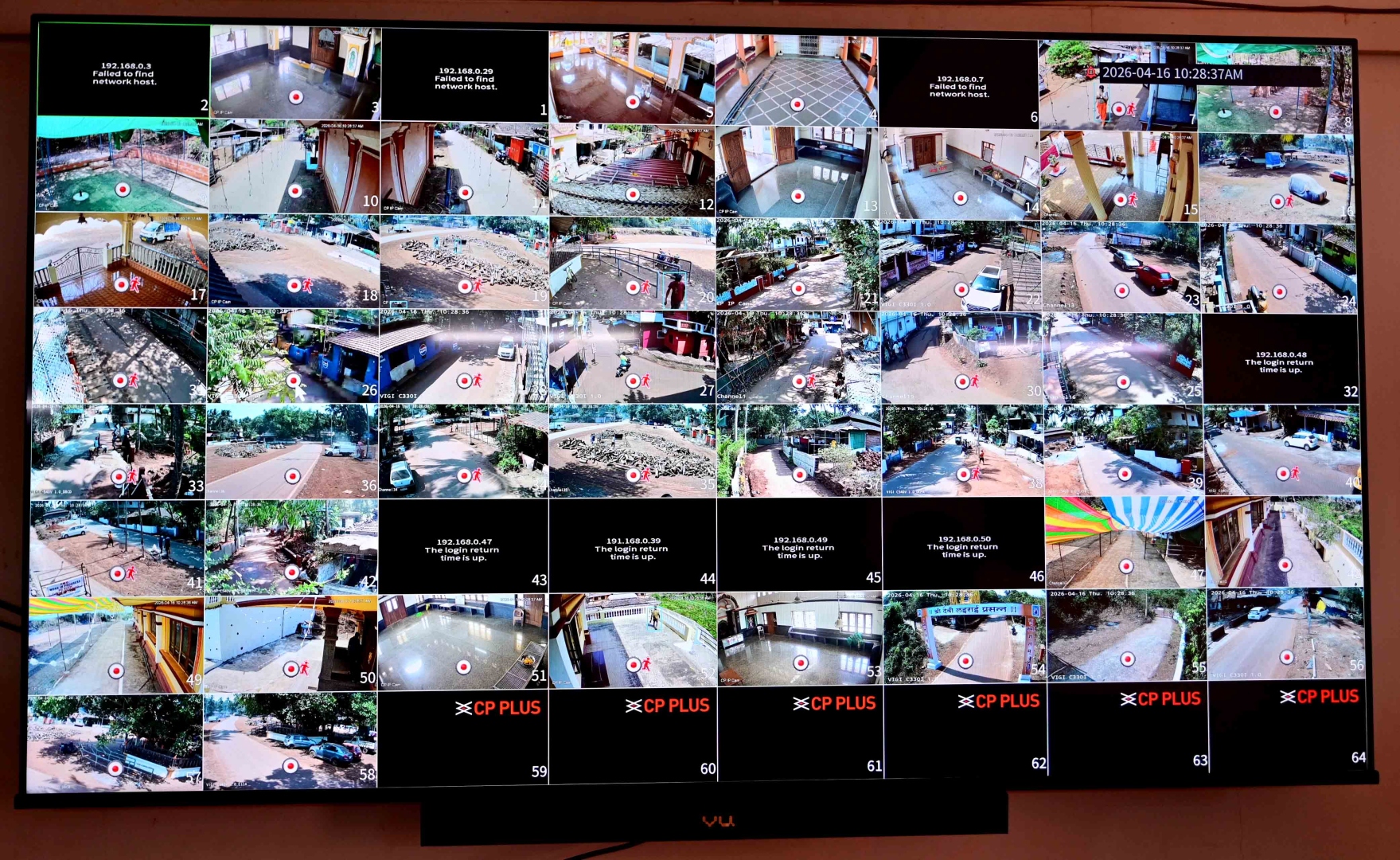
92 CCTV cameras have been installed covering the temple premises.
SHRIGAO
In a bid to prevent any untoward incidents during this year’s Shirgao zatra, the Devi Lairai Devasthan Committee, in coordination with the State administration, has implemented a series of stringent safety and crowd management measures, including keeping the main route virtually free of stalls and deploying extensive surveillance systems.
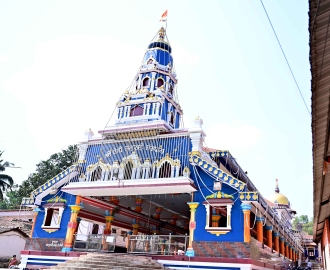
Temple Committee President Dinanath Gaonkar said that for the first time, as many as 92 CCTV cameras have been installed covering the temple premises, the two-kilometre main road stretch leading to the pond (tallem), and other critical areas. A public address (PA) system has also been set up to relay real-time instructions to devotees.
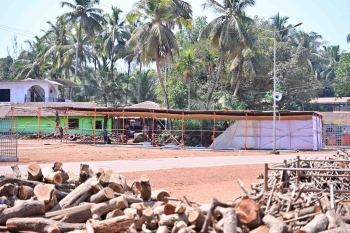
“The main two-kilometre stretch from the temple to the pond has been completely cleared of stalls this year to ensure smooth movement of devotees. In the past, stalls on both sides reduced road width and caused major obstructions,” Gaonkar said.
Wide access, exit routes
He pointed out that even residents who earlier set up stalls outside their homes contributed to congestion. “This will not be allowed this year. The idea is to keep access and exit routes open and wide,” he added.
Instead, limited stalls have been permitted in designated open areas. Nine stalls supplying only water and soft drinks will operate near the bonfire site (homkhand), while around 25 sweet stalls selling ‘khaje’ will be allowed behind the temple on the first day of the fire-walking ritual. The number of stalls will increase from the second day onward, but the main road will remain free of any encroachments.
Infra improvements
Infrastructure improvements have also been undertaken, with the Public Works Department reducing the steep gradient of the main road by approximately 70 cm to enhance safety for devotees and ‘dhonds’ participating in the rituals.
Gaonkar said the committee has held multiple coordination meetings with the district administration. “The Collector has been closely monitoring preparations, and all departments have been assigned clear responsibilities. Compliance with these directions is crucial for ensuring a smooth action,” he said.
Critical areas
Key departments, including police, fire and emergency services, electricity and health, have drawn up deployment plans. Three ambulances will be stationed at strategic locations – the temple, homkhand and tallem – to respond swiftly to emergencies.
Authorities have also identified the temple area, bonfire site and pond area as critical points requiring heightened vigilance. Importantly, from midnight on the first day, the general public movement on the main road will be restricted, with access reserved only for ‘dhonds’.
Despite last year’s tragic stampede that claimed six lives and injured over 50 people, Gaonkar said the turnout is expected to remain high. “The number of devotees will not reduce. Every year, it increases, and this year will be no different,” he said.
Appealing for cooperation, Gaonkar emphasised that public discipline will be key. “All arrangements are in place, but devotees must act responsibly and follow instructions for everyone’s safety,” he added.