PANAJI
Goa may have escaped the severe heatwave gripping large parts of India, but the State is quietly simmering under a spell of persistently above-normal temperatures — a pattern that meteorologists say is deeply uncomfortable and potentially risky for vulnerable groups.
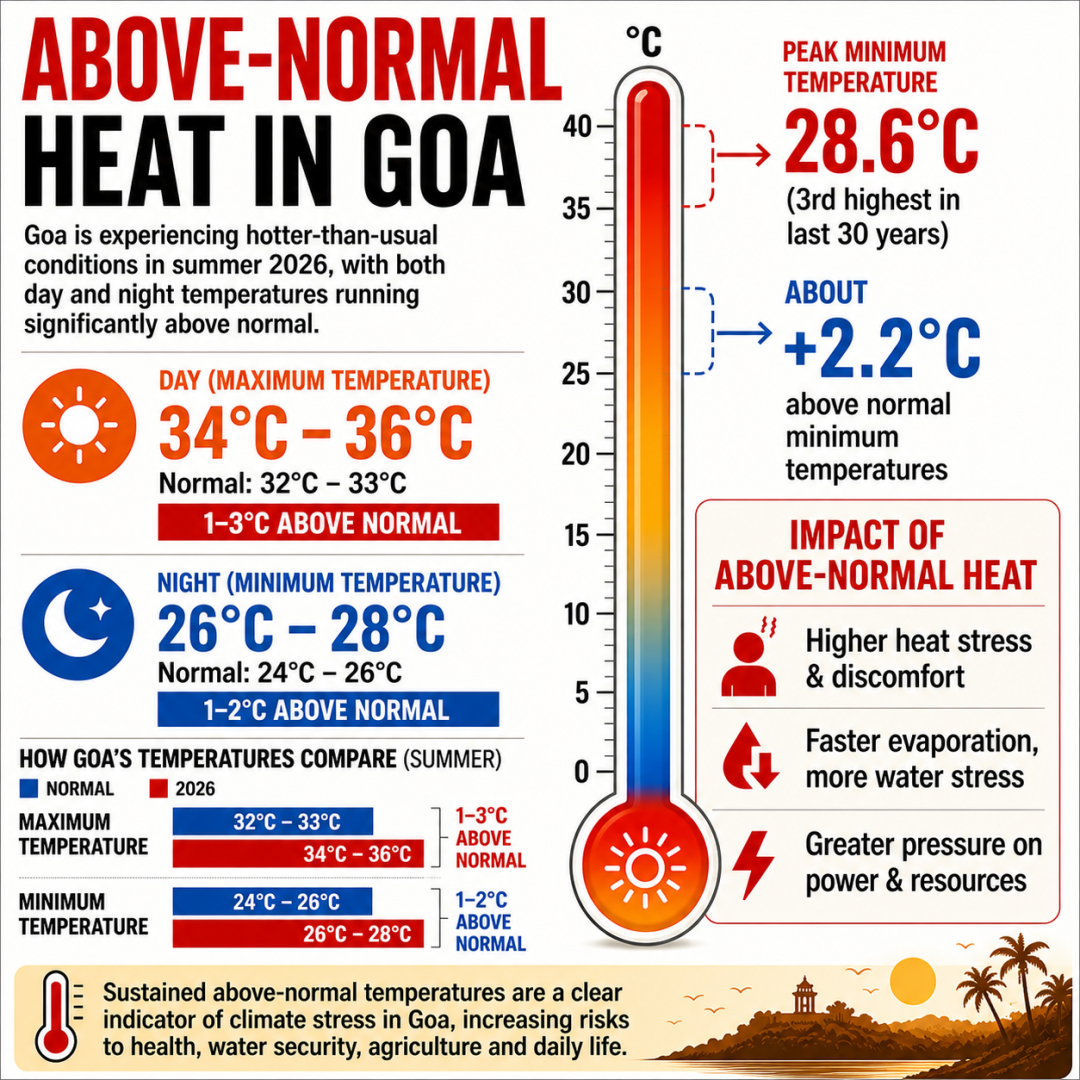
The State’s maximum temperature is hovering between 34°C and 36°C, with minimum temperatures ranging from 26°C to 28°C. Goa recorded its third-highest minimum temperature of 28.6°C in the last 30 years for April 29, which was 2.2 degrees above normal for this time of year.
Although temperatures dipped marginally on Saturday, settling around 34°C max and 26°C min, the relief was largely cosmetic.
India Meteorological Department (IMD) Goa official Nahush Kulkarni confirmed to The Goan that while Goa is not experiencing heatwave-like conditions seen elsewhere, above-normal temperatures continue to prevail. Being a coastal State, these conditions are causing considerable discomfort, he said.
Atmospheric factors at play
The persistence of this heat is being driven by a complex set of atmospheric conditions. As per the IMD, a trough, or wind discontinuity, stretching from South Odisha to the Gulf of Mannar, cutting across Telangana, Andhra Pradesh, and Tamil Nadu, continues to influence weather patterns over the region.
“A long, invisible band of disturbed winds is sitting over parts of India, keeping the air dry and warm. That is why the heat is not easing,” another official explained.
This system has remained active for weeks. For over a week, since April 23, quite a few trough formations and anti-cyclonic circulations over Maharashtra and adjoining regions have combined to suppress rainfall while sustaining warm airflow.
No immediate respite
Meteorological data further showed a near-continuous presence of such systems from Vidarbha to Comorin early in the week, shifting through Karnataka and Tamil Nadu, and extending towards the Gulf of Mannar by April 29. The result has been persistently dry, sunny conditions with little atmospheric relief.
The IMD has forecast dry and mainly sunny weather across Goa for at least the next week, till May 7. In the immediate term, the next 48 hours are expected to bring partly cloudy skies with morning haze, but no significant cooling. Maximum and minimum temperatures are likely to remain steady at around 35°C and 27°C, respectively.
Health risks
While the absence of a formal heatwave classification may sound reassuring, the IMD has flagged moderate health concerns, particularly for infants, the elderly, and those with chronic illnesses. Risks include dehydration, heat cramps, rashes, and, in extreme cases, heatstroke. There is also an increased risk of dry vegetation catching fire, especially in open areas.
The IMD has advised residents to avoid outdoor exposure during peak hours between 11 am and 3 pm, when the heat is most intense. Hydration is critical, with recommendations to consume fluids such as ORS, buttermilk, coconut water, lemon drinks, and traditional cooling beverages.
Outdoor workers have been urged to reschedule strenuous tasks to cooler parts of the day, while organisers of public gatherings have been asked to exercise caution during peak heat hours.
Climate signals
According to IMD projections for May 2026, above-normal temperatures are expected across parts of southern peninsular India. Higher-than-normal minimum temperatures could lead to warmer nights, and above-normal heatwave days are likely in parts of Maharashtra and neighbouring regions.
At the same time, climate indicators suggest a shifting global pattern. ENSO-neutral conditions are gradually transitioning towards El Niño, which could influence the upcoming southwest monsoon.