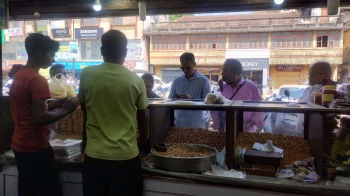
The aroma of the freshly roasted grams and peanuts (chane-bhikna) is so inviting that those walking in the congested Mapusa market are tempted to stop and take hurried steps towards these three small shops standing adjacent to each other in the (new) Mapusa market to place a quick order “ ‘Ek chane-bhikna mix di re’ (give me a mixed packet of grams and peanuts).
The boys at the counter are prompt to listen. Habitually, they pull a plastic bag, take the wooden measuring bowl “ round or square “ fill it in the bag as per order, and tie with a small white thread that the grocery shops used in the good old days, before they handover the packet to the customer. All this said and done in just a few seconds!
Rubber bands are not used to tie these bags. Instead the eco-friendly cotton thread, that was once very much common in grocery shops in Goa, is used here. When everything was packed in newspapers and tied with this white thread, most homes had a bundle of such collected thread pieces that came handy when anything needed to be gift-wrapped and parceled. The chana shops use the same method that was used in the good old days.
One of the shops, P R Usapkar Chana Bhatti, probably the oldest chana bhatti in Mapusa, seems to be still going strong even after more than seven decades of its existence. Shifted at the current place in 1960 the shop was earlier running from Old Mapusa market for 15 years by late Prabhakar Rama Usapkar who, apart from running a chana bhatti, set stalls at four fests “ Anjuna, Mapusa, Saligao and Hadfade, carrying his stuff on a bullock cart.
“My father started the shop 75 years ago at the old Mapusa market near Alankar theatre. The shop was shifted to the current premises in 1960 on this piece of land that belonged to us. The then Municipality built shops here and my father got a shop, which I run now after him,” shares Rameshwar Usapkar, son of late Prabhakar. This friendly man at the counter is the eldest among four brothers and the only one to run the shop after his late father who passed just five months ago at the ripe age of 95.
“Except me, my three younger brothers are educated and well-settled. I did not complete my education but took interest in learning the nuance of the business from my father. The brothers are supportive whenever I need any help. We live in a joint family and celebrate all festivals together. My son Shivam helps me too,” shares Rameshwar, 65.
Busy collecting cash from the customers, Rameshwar has been sitting at the shop since he was a kid. He seems to know most of the customers who call him ‘Dada’. Men and women of all ages keep coming in to buy chane-bhikna, or vatane. Some buy chirmulyo (churmure) or bhajke fov (roasted puffed rice used to make chivda) while others order laahyo (popcorns).
The Bhatti is on all the year round and laahyo are available in all seasons. People in Goa use different types of laahyo on different occasions in the festivals and rituals, and come to Mapusa to buy as per their requirement. These laahyos (popcorns made of corn, rice and jowar) are used in Goa for multiple reasons. The temples use bhatachyo lahyo (rice) during various religious rituals “ Navchandi, Hom, Ganesh Jayanti, Gan Hom etc. For Tulshi Vivah and Goan weddings the demand for Chirmulyo and laahyo rises. Jowar laahyo are used as Prasad and distributed to devotees at special occasions in temples and even at home. As the staple food, rice is not consumed during fasting in Goa, so rice laahyo is not used as Prasad. Hence Jowar is used. Maka (corn) laahyo are used by the devotees who are on walking pilgrimage to Pandharpur.
The shop adjacent to it, Mayekar Chana Centre again, sells the same stuff - chana, bhikna, chirmulyo… Umesh Mayekar and his son Gaurav Mayekar run the shop. “My father Umesh Mayekar started the shop many decades ago, and I have been helping him for the past few years,” says Gaurav.
The shop at the corner of the building is Mahalaxmi Chana Centre “ again selling chanas. However, the person who runs it is a woman, Reshma Mahadeshri. “Reshma handles the business, I just sit and help,” said Suresh Gaonkar, the man sitting behind the counter.
At Kadamba Bus Stand in Panaji, another chana shop is the favourite of passengers. “We bring freshly roasted chana every week from Daman at wholesale price and sell it here in retail,” said the person. Chanekars in the State are in demand, and people buy chanas for time-pass during travel. A vendor selling snacks disclosed that after the GST cut, the price of chana has reduced. Hence he has reduced his price per packet from Rs 15 to Rs 10, but he is honest enough to point out that he has also reduced the quantity of the chana in the packet.