 The writer is a professor at Columbia University in the USA who hails from Cortalim
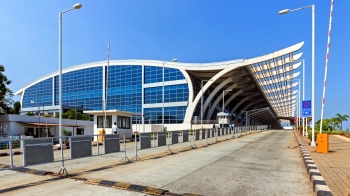
For decades, Dabolim airport has been more than a transport hub. For South Goa, it has been a lifeline, economically, socially, and emotionally.
Dabolim airport began as a military airfield during Portuguese rule in the 1950s. After Goa’s liberation in December 1961 under the Government of India, the airfield was taken over by Indian authorities. Control was transferred to the Indian Navy and commissioned as INS Hansa in 1961“62. This was not a sale or commercial transaction, but an administrative and strategic transfer following Liberation. The airfield became a naval air station for defence purposes.
Recognising Goa’s growing connectivity and tourism needs, the Government later developed a civil enclave model, in which the Navy retained operational control of the runway while civilian flights operated within coordinated time windows. This dual-use arrangement defined Goa’s aviation framework for decades.
Despite constraints due to naval operations, Dabolim airport became central to Goa’s tourism-driven economy. Hotels, taxi operators, restaurants, small businesses, and countless families built livelihoods around the steady flow of passengers through its gates.
First wave of anxiety
When Mopa Airport (now Manohar International Airport) in North Goa was conceived, its construction was presented as an expansion of tourism and accessibility to the north , not a replacement.
Yet from the outset, residents of South Goa feared a different outcome: Would Dabolim airport eventually be handed back entirely to the Navy? Would commercial flights shift north, hollowing out the South’s economy?
Political leaders at the time gave clear and public assurances that Dabolim airport would continue as a civilian airport and would not be reduced to exclusive naval control. Those commitments stabilised public confidence.
However, over the years, this trust steadily began to erode. It started with most Middle East airlines shifting operations to Mopa, though it is not known at whose behest. While airlines make commercial decisions based on infrastructure and scheduling flexibility, the visible migration of international carriers has created a perception that Dabolim airport is being quietly sidelined.
Reassurances and doubts
In recent years, and even as recently as less than a month ago, Goan leaders from the ruling party have made repeated visits to Delhi to “seek reassurances” from the Civil Aviation and Defence Ministries about Dabolim airport’s future.
The frequency of these visits has raised uncomfortable questions. If assurances were firm, why are they being sought again? If Goa’s representatives are confident, why does the issue require repeated negotiation? Just as with invading casinos and the extra tracks for coal being steamrolled through our villages, don’t our local leaders have a voice? Should decisions that affect our health and well-being, our social and cultural fabric, and our way of life be made elsewhere?
Repeated reassurances, instead of strengthening confidence, can signal uncertainty. If they are related to upcoming elections, these half-baked sound bites should not be used to fuel anxieties for political gain. Infrastructure that sustains livelihoods must not be used to influence public sentiment.
Fuel to the fire
A recent statement by a ruling party minister suggesting that a private entity may be colluding to take over the airport has deepened suspicion. At the same time, the Member of Parliament representing South Goa has claimed to possess proof regarding developments concerning the airport, proof that has not been made public.
When leaders speak in fragments and hints rather than with clarity, public trust erodes. Transparency is not optional when the economic backbone of a region is at stake.
Why this matters
For South Goa, this is not abstract politics. Thousands of overseas Goans, especially those working at sea, in the Middle East, Europe, and the USA, depend on Dabolim airport for proximity to their villages. Resorts in Colva, Benaulim, Cavelossim, and further south were built around its connectivity. Taxi operators, rental services, guesthouses, and family-run businesses structured investments on the assumption that Dabolim airport would continue functioning as a civilian airport.
Uncertainty alone can slow bookings, reduce investor confidence, and delay expansion plans. All parties, ruling and opposition, must recognise that rumours can alter economic behaviour. Confidence, once shaken, is difficult to restore.
The core issue
The survival of Dabolim airport as a civilian enclave is not merely about infrastructure. It is about trust.
When leaders publicly assure citizens that Dabolim airport will remain operational, that assurance must not be clouded by contradictory hints or opaque negotiations. If operational constraints exist, they must be clearly stated. If restructuring is under consideration, it must be openly debated. If no threat exists, speculation must end.
Playing politics with aviation infrastructure in a tourism-dependent state is risky. Playing politics with public confidence is riskier.
A way forward
What the people of Goa, especially South Goa deserve is straightforward:
1. A formal, written clarification from both the Central Civil Aviation and Defence Ministries.
2. A clear long-term operational framework for Dabolim airport.
3. Transparent communication on how Dabolim and Mopa airports will function together.
4. An end to speculation-driven political statements, particularly in the run-up to elections.
Dabolim airport has served the country and Goa faithfully for decades, as a naval base and as a shared civilian gateway. It has adapted and sustained livelihoods across South Goa.
This issue is not only about connectivity. It concerns governance and credibility. Decisions affecting Goa’s strategic and economic assets must be communicated openly and backed by documented policy positions. Public confidence cannot rest on corridor whispers or fragmentary statements. It requires clarity.
If the Goa Government or those in opposition have proof that Dabolim airport will not be shut down or diluted, that proof should be placed transparently in the public domain. Governance must rest on documentation, not speculation.
What Goa now needs is not political manoeuvring, but clarity. Because when trust begins to wobble, even the strongest runway can feel unstable.